
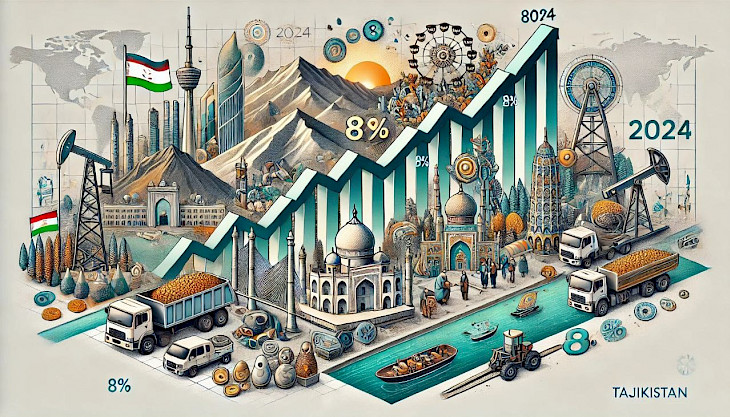
DUSHANBE – Analysts at the Eurasian Development Bank (EADB) expect Tajikistan's real GDP to grow by 8.1% in 2026, according to the bank's March edition of its Macroeconomic Review. This forecast aligns closely with the official expectations of the Tajik government, which has set a target of no less than 8.0% growth, Asiaplus.tj reports.
"This will be supported by the continuation of positive trends in consumption and investment, underpinned in part by export revenues generated by enterprises," note EADB experts.
According to the bank's analysts, the primary engines of economic expansion include:
- Energy sector – substantial state investments in expanding power generation capacity;
- Manufacturing industry – including textiles and food processing;
- Mining sector – extraction of ores and metal production, particularly gold;
- Remittances from labor migrants – remaining a critical source of domestic demand support.
Favorable global price conditions, especially for gold—one of Tajikistan's main export commodities—are also helping to sustain strong foreign trade earnings.
As highlighted in the review, Tajikistan's economy continued to demonstrate robust growth in January 2026, driven by resilient consumer and investment demand. Significant capital inflows are being directed toward the energy sector under the national development strategy, as well as into industrial projects ranging from mineral extraction to finished goods production.
The current EADB projection essentially reaffirms the estimates the bank provided in late 2025. It also correlates with the official rhetoric of Tajik authorities: in a recent address, President Emomali Rahmon stressed the need to maintain GDP growth of at least 8% through industrialization, expanded energy capacity, development of processing industries, and investment attraction.
However, certain nuances emerge in how the sources of growth are interpreted:
|
EADB Perspective |
Official Tajik Position |
|---|---|
|
Focus on external factors: commodity prices, stability of migration flows, export potential |
Emphasis on domestic drivers: structural reforms, industrialization, productivity gains |
|
Key drivers: gold and non-ferrous metal exports, remittances |
Key drivers: industrialization, energy security, import substitution |
Experts note that this divergence does not represent a contradiction but rather highlights an important strategic challenge: to achieve medium-term goals of doubling GDP and reducing poverty, Tajikistan will need to enhance its economy's resilience to external shocks and accelerate the transition from extensive, quantity-driven growth to a model based on productivity gains, creation of quality jobs, and expansion of the domestic market.
CentralasianLIGHT.org
March 19, 2026