
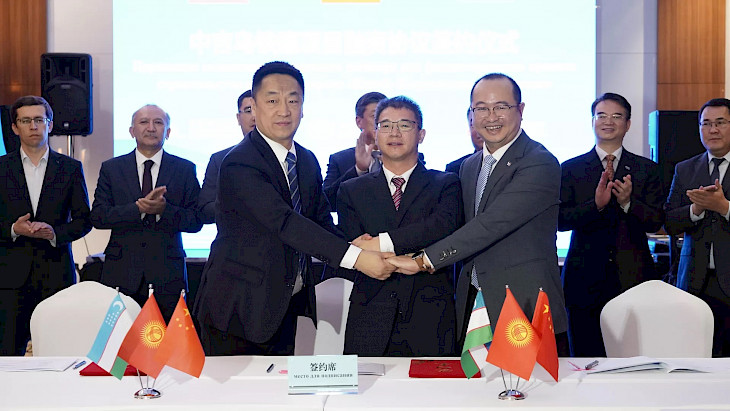
The Government of Kyrgyzstan has confirmed the signing of a loan agreement that secures the financial framework for the implementation of the strategic China–Kyrgyzstan–Uzbekistan (CKU) railway project, according to the press service of the Kyrgyz Cabinet of Ministers.
The agreement was concluded between the joint project company established by the three countries and a syndicate of leading Chinese financial institutions, including the China Development Bank and the Export-Import Bank of China.
The total cost of the project is estimated at $4.7 billion. Of this amount, $2.3 billion will be provided by the Chinese side as a long-term loan with a maturity of up to 35 years. The loan will be serviced and repaid directly by the project company from future revenues generated by railway operations. The remaining $2.3 billion will be formed through contributions to the company’s authorized capital: 51% will belong to China, while Kyrgyzstan and Uzbekistan will each hold 24.5%.
Deputy Chairman of the Cabinet of Ministers of Kyrgyzstan Bakyt Torobaev emphasized that the timely closure of the financial package was a key condition for moving the project into its practical implementation phase. According to him, the agreements reached demonstrate a high level of political coordination and the readiness of the parties to implement one of the largest infrastructure projects in the region. Zhou Xing, General Director of the project company, noted that priorities include transparent management of funds, adherence to construction schedules, and compliance with international standards.
According to updated parameters, the length of the railway across Kyrgyzstan will be approximately 304 kilometers. The project is characterized by high engineering complexity: construction plans include 50 bridges and 29 tunnels with a total length of about 120 kilometers, reflecting the country’s mountainous terrain. The railway is expected to become a key element of a new transit corridor linking China with Central Asia and further with the markets of the Middle East and Europe, significantly reducing transportation time and costs.
The project is expected to strengthen Kyrgyzstan’s transit potential, create thousands of jobs during both the construction and operational phases, and serve as a driver for the development of logistics, industry, and related infrastructure.
CentralasianLIGHT.org
December 17, 2025