
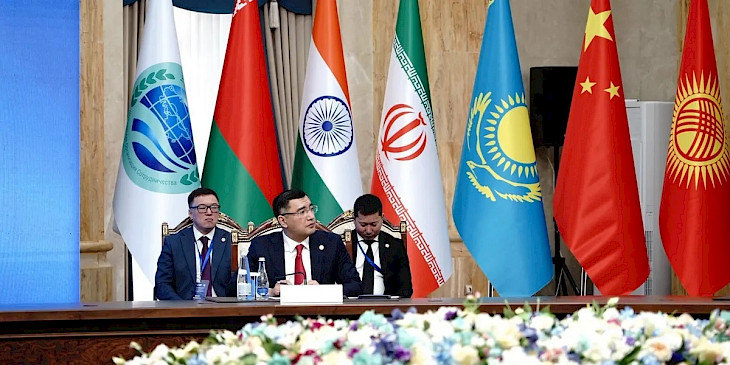
The heads of the Shanghai Cooperation Organization's railway administrations in Bishkek solidified a strategic course for the integration of transport systems at their Sixth Meeting. Their joint meeting was chaired by the head of Kyrgyz Temir Zholu (KTZ), Economist.kg reports.
Meeting participants discussed the possibility of expanding transit corridors and accelerating the digitalization of logistics processes. Representatives from Kyrgyzstan, Belarus, India, Iran, Pakistan, Kazakhstan, China, Russia, Tajikistan, and Uzbekistan participated in the event.
KTZ General Director Azamat Sakiev reported that over the past two years, freight traffic between Kyrgyzstan and SCO member states has increased by 33%, made possible by consistent efforts to eliminate administrative barriers and implement modern technologies. A key achievement for the Kyrgyz side was the launch in 2025 of the automated "Unified Model of the Transportation Process" system, which tracks freight movement in real time and synchronizes the actions of all supply chain participants.
"Digitalization isn't just a technical upgrade; it's the foundation for a qualitative leap in transportation efficiency. Our system allows us to reduce cargo clearance time by 40%, minimize paperwork, and ensure transparency at every stage," Sakiev emphasized.
Meeting participants discussed the implementation of the decisions of the fifth SCO meeting, the progress of the Concept for Interaction between Railway Administrations until 2027, as well as infrastructure modernization and tariff policy harmonization. Particular attention was paid to personnel training: the parties agreed to launch joint educational programs and exchange experience between specialized universities in the participating countries.
Following the talks, a final protocol was signed, which formalizes mechanisms for coordinating transit shipments, synchronizing investment projects, and developing multilateral cooperation. The document will serve as the basis for the development of sustainable Eurasian transport arteries capable of competing with global logistics routes.
CentralasianLIGHT.org
April 1, 2026