
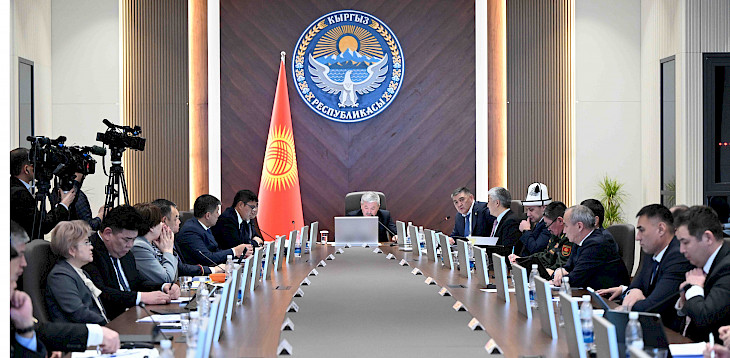
The Chairman of the Cabinet of Ministers of the Kyrgyz Republic, Adylbek Kasymaliev, has approved the Action Plan for implementing the National Development Program until 2030, aimed at ensuring sustainable economic growth and structural modernization of the country, reports Economist.kg.
The document targets an annual GDP growth rate of 8% and outlines 900 concrete initiatives grouped under eight strategic priorities.
Key national goals include:
- Raising GDP to $30 billion;
- Increasing GDP per capita to $4,500;
- Entering the top 30 countries in achieving the UN’s Sustainable Development Goals;
- Improving the country’s ranking in the Human Development Index by 10 points.
The program is built on four strategic pillars: industrialization, transit and logistics development, green energy, and the advancement of agriculture and tourism.
Under the industrialization pillar, the government plans to establish a National Industrial Development Fund, launch pilot industrial clusters, create a nationwide network of technoparks and business incubators, and introduce preferential lending mechanisms for energy-efficient technologies.
The logistics strategy seeks to reinforce Kyrgyzstan’s role as a Eurasian transit corridor. Priority projects include:
- Completing the China–Kyrgyzstan–Uzbekistan railway;
- Modernizing the Torugart and Irkeshtam border checkpoints;
- Commissioning the new Bedel border crossing;
- Constructing the Barskoon–Uch-Turfan–Aksu international highway;
- Developing a Kyrgyz-Kazakh trade and logistics complex near the Ak-Tilek and Karasu border crossings.
In the energy sector, the focus is on hydropower development. Planned projects include Kambar-Ata HPP-1 and cascades of hydropower plants on the Naryn, Sary-Jaz, and Chatkal rivers—including the Kulanak, Kazarman, and Suusamyr-Kokomeren HPPs. To support electricity exports, 500 kV high-voltage transmission lines will be built along the Kemin–Torugart and Datka–Torugart corridors.
In agriculture, Kyrgyzstan is transitioning to organic farming, with organic crop areas projected to reach 202,000 hectares by 2029. The plan also includes establishing Class “A” agro-logistics centers and implementing automated water resource management systems.
The successful implementation of this comprehensive program is expected not only to accelerate economic growth but also to improve citizens’ quality of life, strengthen Kyrgyzstan’s regional standing, and ensure sustainable development through 2030.
CentralasianLIGHT.org
December 30, 2025