
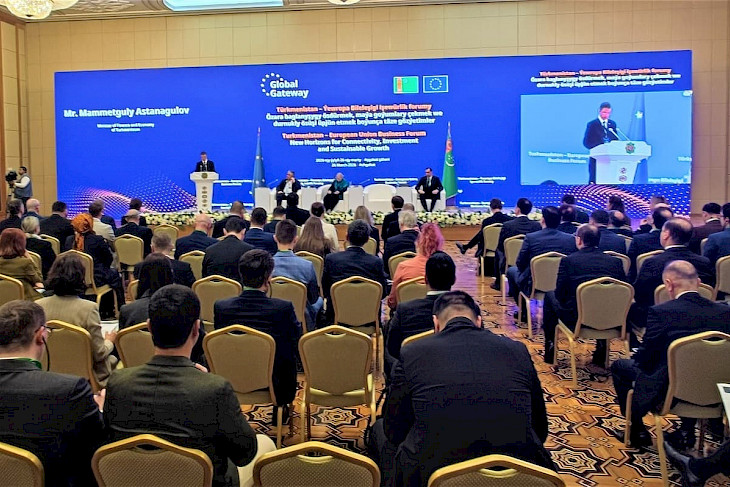
ASHGABAT - The speech by Turkmenistan's Minister of Finance and Economy, Mammetguly Astanagulov, at the International Business Forum in Ashgabat marked a turning point in understanding the true state of the country's trade and economic relations with the European Union. The head of Turkmenistan's economic department not only reaffirmed the strategic nature of the partnership with the EU but also presented a detailed analysis of problem areas requiring urgent solutions, Orient.tm reports.
The statistics speak for themselves: by the end of 2025, foreign trade turnover with EU countries amounted to approximately $2.1 billion, declining 17.7% compared to the previous year. Exports fell by 21.2%, and imports by 11%. The share of EU countries in Turkmenistan's total trade fell to 10%, a loss of 3 percentage points.
However, these figures conceal an important message: over 63% of this turnover comes from exports of Turkmen products. This demonstrates Europe's continued interest in goods from Turkmenistan and their high competitiveness. The main challenge is logistics: geopolitical risks and a sharp rise in transportation costs have become a significant barrier.
The Minister emphasized the transition from one-off transactions to systemic integration. Turkmenistan is already using EU technical assistance tools, in particular the Ready4Trade program, which has resulted in the launch of a national Trade Portal and the development of e-commerce.
A key project is the €6 million Global Gateway initiative, launched in March 2024 and scheduled to run until 2028. It aims to ensure the integration of Turkmen businesses into European value chains.
The completion of the Memorandum on Foreign Trade Regime, a key document for WTO accession, was a key signal for investors. At the same time, large-scale improvements to trade and investment legislation are underway, adapting the legal framework to international standards.
Cooperation with the OECD and expert assessment of the business environment are all steps toward creating transparent rules of the game. The 2025 statistics are not a reason for pessimism, but a clear benchmark: investments in transport infrastructure and industry can offset logistical losses and open up new horizons for cooperation.
CentralasianLIGHT.org
March 27, 2026