
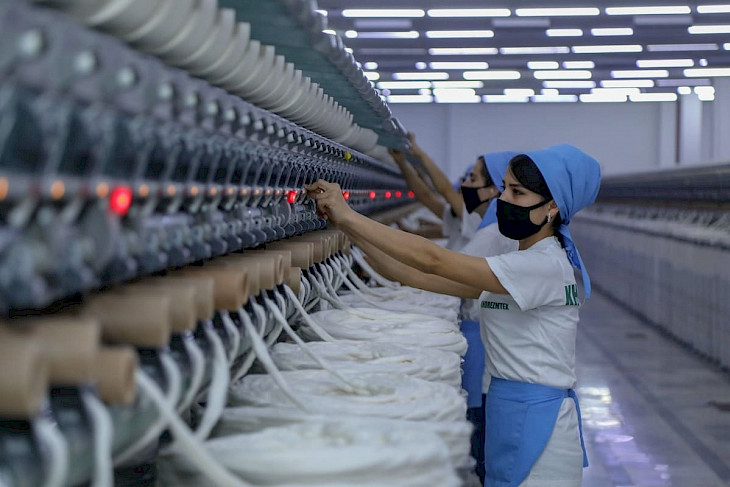
In 2025, Uzbekistan’s textile industry demonstrated steady growth across all key indicators. Production volume reached 134 trillion sum—the highest level in the sector’s history. Foreign investment inflows amounted to USD 2.1 billion, reflecting growing international interest in Uzbekistan’s textile cluster, according to the press service of the President of Uzbekistan.
Exports rose compared to 2024, reaching USD 2.5 billion. Employment also increased: 623,000 people are now employed in the textile sector, a figure that continues to grow due to production expansion and new project development.
During a meeting chaired by President Shavkat Mirziyoyev, ambitious targets for 2026 were outlined: production is expected to reach 147 trillion sum, while exports are projected to grow to USD 3.3 billion. To achieve these goals, USD 2.2 billion in foreign investment is planned for the sector.
Funds will be directed toward establishing new facilities and upgrading existing ones. As a result, by 2026 Uzbekistan will gain additional annual capacity to produce:
— 207,000 tonnes of synthetic and blended yarn,
— 397 million square metres of fabric,
— 224 million units of ready-made garments and knitwear,
— and dye 108 million square metres of textiles.
Particular emphasis will be placed on deepening cotton fibre processing and increasing capacity utilization at plants producing fabrics, knitwear, and finished goods—shifting from raw material exports toward high value-added products.
At the same time, the meeting identified key challenges limiting the sector’s potential:
— Partial reliance on imported cotton fibre, despite domestic cotton production;
— High cost of financing for enterprises;
— Rising logistics costs in external markets;
— Shortage of skilled personnel in several areas, including next-generation technologists, digital designers, and supply chain managers.
Addressing these bottlenecks will be a top priority in 2026. Planned measures include strengthening support for domestic cotton farming, expanding access to preferential financing, developing logistics infrastructure, and launching targeted vocational training and retraining programmes—in collaboration with sectoral colleges and international partners.
Thus, Uzbekistan’s textile industry is steadily advancing toward becoming a key export-oriented pillar of the national economy, with a focus not only on scale, but also on quality, technological modernization, and sustainable development.
CentralasianLIGHT.org
December 26, 2025