
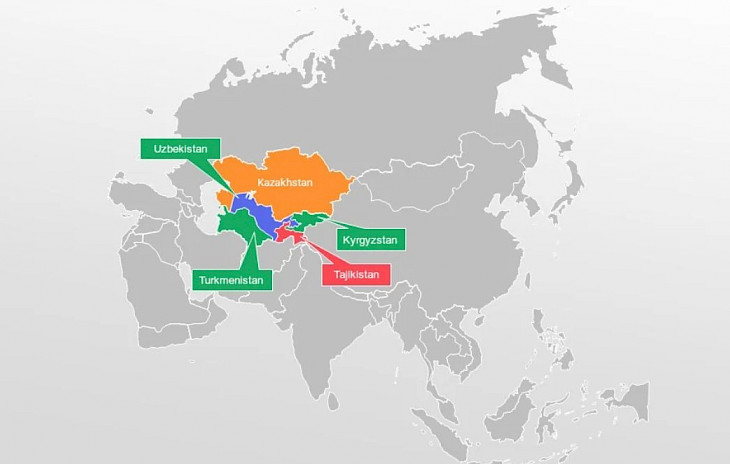
The final week of August showed that Central Asia's economic agenda is increasingly shaped by three interconnected trends: diversification, investment and regional connectivity. While Kazakhstan is dealing with rising public debt, Uzbekistan is expanding non-gold exports, Kyrgyzstan is trying to improve energy efficiency and attract Chinese capital, Tajikistan is looking for new investment and energy partnerships, and Turkmenistan remains focused on strengthening its energy sector while cautiously exploring new areas of cooperation. The following review summarizes the most notable economic developments reported by CentralasianLIGHT.org during August 22–29.
Kazakhstan
Kazakhstan's economy continues to demonstrate significant strength, but the country is also facing growing pressure on public finances. According to data published by CentralasianLIGHT.org on August 27, Kazakhstan's external public debt increased by 6.5% year-on-year in the first half of 2026, reaching $17.2 billion. Total public debt, including domestic liabilities, increased by 14.8% to 38.5 trillion tenge, or approximately $82.9 billion. Domestic debt grew even faster, by 20%, reaching 30 trillion tenge.
The budget deficit also increased substantially, while debt-servicing costs continued to rise. This does not mean that Kazakhstan is facing an immediate fiscal crisis. The country still has by far the largest economy in Central Asia, substantial foreign-exchange reserves and considerable access to international capital. Nevertheless, the figures suggest that Astana will have to pay increasing attention to the balance between public investment, economic modernization and fiscal sustainability.
At the same time, Kazakhstan continued to develop new economic partnerships. One of the most interesting examples was the visit of Singapore Senior Minister Lee Hsien Loong on August 24–27. Kazakhstan and Singapore discussed digital trade, water management and the digitalization of the Middle Corridor. The two sides are particularly interested in improving logistics, supply chains and digital trade procedures.
This is important because Kazakhstan increasingly views the Middle Corridor not simply as a railway and transport route, but as a broader economic platform. Digital customs, logistics and supply-chain management could make the route more competitive and help Kazakhstan strengthen its position between China, Central Asia, the Caspian region and Europe.
The main economic challenge for Kazakhstan, therefore, is no longer simply attracting capital. It is using its substantial financial resources to build a more diversified economy while keeping public debt under control.
Kyrgyzstan
Kyrgyzstan's economic agenda during the week was closely connected with energy efficiency and investment. CentralasianLIGHT.org reported that the country's economic electricity intensity had fallen almost 2.5-fold over five years. This is particularly significant for Kyrgyzstan because the country continues to face growing demand for electricity and the need to modernize its energy infrastructure.
The improvement means that the economy is generating more output with less electricity consumption. However, the trend is not uniform across all sectors. Agriculture, for example, has experienced fluctuations in electricity intensity, indicating that further investment in modern equipment and energy-saving technologies remains necessary.
Investment remains another major priority. Chinese companies are playing an increasingly important role, with CentralasianLIGHT.org reporting that Chinese investment in Kyrgyzstan reached approximately $1.85 billion between 2021 and 2025. The two countries are seeking to expand cooperation beyond traditional trade toward manufacturing, energy, logistics, agriculture, digital technologies and other sectors.
The China–Kyrgyzstan–Uzbekistan railway remains central to this strategy. For Kyrgyzstan, the project is potentially transformational because it could reduce the country's transport isolation and provide direct access to larger regional and international markets.
The tourism sector also offers diversification opportunities. CentralasianLIGHT.org estimates that tourism contributed $20.1 billion to the Central Asian economy in 2025, while Kyrgyzstan remained one of the region's important tourist destinations.
Kyrgyzstan is therefore trying to build several new engines of growth simultaneously. Energy efficiency, hydropower, tourism, foreign investment and transport connectivity could significantly strengthen the economy, but the crucial task will be ensuring that large infrastructure projects generate local production, jobs and export revenues.
Uzbekistan
Uzbekistan demonstrated perhaps the clearest signs of structural economic transformation during the week. On August 28, CentralasianLIGHT.org reported that the country resumed gold exports in July, selling approximately $1.3 billion worth of gold. Gold exports since the beginning of the year exceeded $2.8 billion.
However, the most important element of the report was not the volume of gold exports but the continued growth of exports excluding gold. These increased by 27.7% to $9.8 billion, while textile exports rose by 26.6% to $1.9 billion. At the same time, the share of gold in total exports fell from 36.7% to 14.1%.
This is a significant change. Uzbekistan has long relied heavily on gold as a source of foreign-exchange earnings, but the latest figures indicate that industrial products, services and finished goods are becoming increasingly important.
The transformation, however, is accompanied by a large trade deficit. In January–July, Uzbekistan's foreign trade turnover reached $49.5 billion, while exports amounted to $19.9 billion and imports to $29.6 billion. The resulting deficit was approximately $9.7 billion.
Another important indicator was the rapid growth of the money supply. By August 1, it had reached a record 434.5 trillion soums, approximately $36.8 billion. The increase of 37% over the year reflects expanding banking activity and economic circulation, but it also requires careful monetary management.
Uzbekistan is thus moving toward a larger and more diversified economy. The key question is whether the growth of domestic demand and imports can increasingly be matched by stronger industrial production and export capacity.
Tajikistan
Tajikistan's economic development remains closely linked to external partnerships, energy security and remittances. During the week, the country continued efforts to strengthen economic cooperation with South Korea.
On August 26, Tajik Foreign Minister Sirojiddin Mukhriddin met South Korean Ambassador Jeong Song-shik to discuss bilateral relations and preparations for the Central Asia–Republic of Korea Summit. Particular attention was given to expanding multifaceted cooperation.
For Dushanbe, South Korea represents an attractive partner in areas such as technology, education, digitalization, industrial development and investment. This fits into Tajikistan's broader effort to diversify its external economic relations.
Energy security, however, remains a more immediate concern. Tajikistan has been seeking additional supplies of crude oil and petroleum products from Iran, highlighting the country's dependence on imported fuel. At the same time, hydropower remains the strategic foundation of Tajikistan's long-term economic plans.
The country's wage statistics also reveal the limitations of current growth. Average nominal wages increased by more than 21% year-on-year, but Tajikistan continues to have one of the lowest average wage levels in Central Asia. This gap highlights the difference between macroeconomic growth and household incomes.
Remittances remain another structural vulnerability. They provide essential support for household consumption and foreign-exchange reserves, but dependence on migrant income means that changes in labor markets in Russia and other destination countries can quickly affect Tajikistan's economy.
The challenge for Dushanbe is therefore to convert infrastructure investment and economic growth into domestic productive capacity, better-paid employment and stronger exports.
Turkmenistan
Turkmenistan's economic situation remains dominated by the energy sector. On August 25, CentralasianLIGHT.org reported that LPG sales through the State Commodity and Raw Materials Exchange declined by 31% in January–July 2026, reaching 120,500 tons.
The main reason was a sharp reduction in sales by the Turkmenbashi Oil Refinery, where exchange volumes fell by 64%. Other producers increased their sales, but not enough to compensate for the decline.
The figures illustrate an important feature of the Turkmen economy: despite its enormous natural-gas resources, individual production and refining facilities continue to have a significant impact on export performance.
At the same time, Ashgabat is gradually expanding cooperation in areas outside traditional hydrocarbons. During the week, Turkmenistan and Pakistan discussed digital transformation and telecommunications, reflecting the country's growing interest in information technology and digital infrastructure.
Turkmenistan is also strengthening economic ties with Kazakhstan, particularly in transport, customs and regional cooperation. Electronic exchange of customs data between the two countries is intended to simplify border procedures and facilitate trade.
The broader objective is clear. Turkmenistan wants to retain its position as a major energy producer while gradually adding transport, digitalization and industrial processing to its economic model.
Regional Outlook
The economic developments of August 22–29 point to a region that is becoming more interconnected and increasingly focused on diversification.
Kazakhstan continues to dominate the region in terms of investment and economic scale, but rising public debt requires greater fiscal discipline. Kyrgyzstan is trying to use infrastructure, energy and Chinese investment to overcome structural limitations. Uzbekistan is gradually reducing the relative importance of gold and increasing non-commodity exports. Tajikistan is seeking new investment and technology while remaining vulnerable to remittance and energy pressures. Turkmenistan continues to depend heavily on hydrocarbons but is cautiously expanding into new sectors.
One trend connects all five economies: connectivity is becoming an economic strategy. Railways, digital trade, logistics, energy networks and investment corridors are no longer viewed as separate projects. They are increasingly part of a broader effort to reposition Central Asia within the Eurasian economy.
The next stage will be more difficult. Infrastructure alone will not guarantee sustainable growth. The region will need to ensure that new transport routes generate manufacturing, exports and jobs; that foreign investment produces technology transfer; and that economic growth translates into higher living standards.
For Central Asia, therefore, the main economic story of the week is not simply growth. It is the gradual transition from economies based primarily on resources, remittances and geography toward economies increasingly driven by investment, connectivity, technology and diversification.
CentralasianLIGHT.org
August 29, 2026