
Central Asia Week in Review: A Corruption Shock in Astana, Climate Diplomacy in Antalya and an Election Countdown in Bishkek (November 8–15, 2026)
Central Asia’s week was shaped by three storylines that ran side by side. In Kazakhstan, the arrest of the heads of the sovereign wealth fund and the national railway company became the biggest anti-corruption case the country has seen since its new Constitution took effect. In Antalya, where Türkiye hosted the COP31 climate summit, all five Central Asian states used the stage to present themselves as regional climate actors, with glaciers, water and the Aral Sea at the centre of their pitches. And in Kyrgyzstan, the presidential campaign moved into a new phase as applications closed and the president warned of attempts to stir ethnic tension in the south. Behind these headlines, a steady stream of investment, infrastructure and security news showed how fast the region’s economic and geopolitical ties are being redrawn.
Kazakhstan: Arrests at the Top of the State Economy
The most dramatic news of the week came from Astana. On November 11, the Anti-Corruption Service of the National Security Committee (KNB) detained Nurlan Zhakupov, chairman of the management board of Samruk-Kazyna, and Yelzhas Otynshiyev, head of the national railway company Kazakhstan Temir Zholy (KTZ), along with several other suspects. The KNB released no details of the charges, citing the secrecy of the investigation. Zhakupov had led the fund since April 2023. Otynshiyev had run the railway for less than four months.
The scale of the case is hard to overstate. Samruk-Kazyna controls assets that account for a large share of Kazakhstan’s economy, from oil and gas to rail, energy and telecommunications. In February the fund cut about 650 administrative jobs after President Kassym-Jomart Tokayev criticised it for having too many managers.
On November 13, Tokayev addressed the case at an operational meeting of the Security Council. He called the detentions “an extremely serious signal of large-scale corruption in state companies.” He said this was the first major case since the principle of “Law and Order” was written into the new Constitution, which took effect on July 1. “Violating the Constitution, and even mocking this sacred document, is not permitted to anyone,” the president said. He announced a special State Commission to oversee public spending on roads, airports, clinics, schools and sports facilities under the “People’s Construction” programme, with its members to be named early next week.
The scandal hit as Kazakhstan’s economy was performing well on paper. GDP grew 4.5% in January–October, slightly faster than after nine months. Manufacturing accelerated to 9.3%, led by pharmaceuticals (up 50.9%) and machinery (up 22.2%). The government aims to double the economy by 2029 and reduce its dependence on oil, whose output has been held back by OPEC+ quotas and disruptions on the Caspian Pipeline Consortium route. Astana briefed foreign ambassadors on investment priorities in energy, agriculture, digital technology, water infrastructure and critical minerals, highlighting the Bakhty–Ayagoz railway and an 800-km Aral–Caspian highway. Trans-Caspian freight rose by nearly 30% in nine months. The Asian Infrastructure Investment Bank identified up to $6 billion in possible Kazakh projects, and QazaqGaz began talks with Austria’s state holding ÖBAG on gas production and underground storage.
Kazakhstan’s nuclear ambitions also moved forward. Almasadam Satkaliyev, head of the Atomic Energy Agency, visited Turkey’s Akkuyu nuclear power plant on November 12 and invited the Kazakh specialists working there to come home. Kazakhstan plans at least three nuclear power plants and in September signed a contract with Rosatom’s Atomstroyexport to build the first. The country has had no operating reactor since the BN-350 in Aktau closed in 1999, so finding qualified staff is one of its biggest challenges.
Kyrgyzstan: An Election Countdown Under Pressure
In Kyrgyzstan, the January 27, 2027 presidential election dominated the agenda. Applications closed at midnight on November 12 with eleven hopefuls. The last to apply was Klara Sooronkulova, a former judge of the Constitutional Chamber and the only woman in the race. The applicants include incumbent President Sadyr Japarov, who is seeking a second term, former MP Iskhak Masaliev and former head of the Financial Police Syimyk Zhapykeev.
On November 12, Japarov published a warning on Facebook. He said “unscrupulous politicians” were plotting to provoke a Kyrgyz-Uzbek conflict in the south before the vote. He named no one and said the plans were so far only talk. But he urged elders to talk to young people aged 20 to 25 and warned that false rumours could spark conflict “out of nothing.” The warning carries weight in a country that still remembers the deadly clashes in Osh and Jalal-Abad in 1990 and June 2010, when more than 400 people were killed.
The economic backdrop is uneasy. Kyrgyzstan’s industrial producer prices rose 24% year on year in September, the highest rate in the Eurasian Economic Union and nearly three times the bloc’s 8.4% average. Water supply and waste management led with a 43.1% increase. Because producer prices usually feed into consumer prices within months, this complicates the National Bank’s fight against inflation in the run-up to the election.
Energy remains the country’s weak point. Kyrgyzstan expects to import about a fifth of its winter electricity demand. A five-year, $35 million World Bank-backed programme, iFIRST, was launched to modernise the grid, support the 1,860-MW Kambarata-1 hydropower project, which donors have signalled about $2.5 billion for, and protect low-income households if tariffs rise. Japarov also said the Kumtor gold mine, the country’s largest, will keep operating until at least 2050, rejecting reports that it would close in 2032.
Two more items showed Bishkek’s wider ambitions. The government published a draft space programme for 2027–2031, the first in its history. It aims to build a national Earth observation system by 2031, starting with glacier, water and natural hazard monitoring. The Cabinet also approved an agreement under which Russia will fund Kyrgyzstan’s Drug Control Service through 2028. Kyrgyzstan sits on the Northern Route used to smuggle Afghan opiates through Central Asia.
Bishkek also hosted the annual meeting of the UN Special Programme for the Economies of Central Asia (SPECA). Participants adopted the Bishkek Declaration and approved three new joint projects on dam safety, multimodal transport and the green economy. Uzbekistan will chair SPECA in 2027.
Security: The CSTO and the Afghan Border
The Collective Security Treaty Organization met in Moscow on November 11. Leaders of Russia, Belarus, Kazakhstan, Kyrgyzstan and Tajikistan adopted a declaration and 18 documents, including an anti-terrorism strategy through 2030. Tajikistan will take over the chairmanship on January 1, 2027.
For Dushanbe, the key issue is the 1,350-km border with Afghanistan. A CSTO programme to reinforce the border runs until 2029: the most vulnerable sections are to be equipped in 2026–2027, and the first equipment from Russia, Belarus, Kazakhstan and Kyrgyzstan is due by the end of this year. CSTO Secretary General Taalatbek Masadykov stressed that the programme “is not directed against Afghanistan and its people.”
On November 12, President Emomali Rahmon held separate talks with Vladimir Putin in Moscow on security, trade, energy and labour migration. Remittances from Tajik migrants, mostly in Russia, equal about 40% of Tajikistan’s GDP, which makes Moscow indispensable for Dushanbe. At the same time, Tajikistan kept broadening its partnerships. On November 11 its anti-corruption agency signed a memorandum with Saudi Arabia’s Oversight and Anti-Corruption Authority (Nazaha) during an international forum in Dushanbe.
COP31: Central Asia Speaks With One Climate Voice
The COP31 leaders’ summit in Antalya, held on November 11–12, became Central Asia’s main international stage of the week, and each country arrived with its own initiative.
Uzbek President Shavkat Mirziyoyev proposed a “climate integration model” for Central Asia, based on sharing climate data, eco-technologies and joint finance. “No country can solve climate problems alone,” he said. He noted that Uzbekistan has cut emissions per unit of GDP by 35%, targets 50% by 2035, and aims to generate 54% of its electricity from renewable sources by 2030. The initiative is linked to Uzbekistan’s 2027 chairmanship of the International Fund for Saving the Aral Sea.
Turkmenistan brought the broadest package. It proposed a UN Decade of Climate Resilience and Adaptation for 2028–2037, an “Ashgabat Climate Dialogue” from 2027, an International Environmental Code and a regional centre to combat desertification. Foreign Minister Rashid Meredov promoted a Regional Centre for Climate Technologies, due to open in Ashgabat in early 2027, in talks with UN-OHRLLS, the Global Green Growth Institute and ICESCO. Satellite monitoring has repeatedly linked Turkmenistan’s gas fields to large methane leaks, a contradiction that will follow its climate diplomacy.
Tajikistan led a side event on glaciers on November 12, co-organised with Kyrgyzstan, Nepal, Pakistan and Bhutan. Participants called for predictable, long-term funding for mountain countries, which are seeing their glaciers retreat. No specific pledges were announced.
Antalya also hosted bilateral diplomacy. Mirziyoyev met World Bank President Ajay Banga, and they noted that the joint portfolio is approaching $16 billion. He also met Finnish President Alexander Stubb, and the two agreed to speed up projects in metallurgy, energy and geology. Earlier in the week, on November 10, Turkmenistan’s National Leader Gurbanguly Berdimuhamedov met President Recep Tayyip Erdoğan in Türkiye, and the two reaffirmed the “One Nation – Two States” formula.
Uzbekistan’s Industrial Bet and Regional Finance
Away from the summit, Uzbekistan announced 164 electrical engineering projects worth $11.6 billion over three years. The largest share, $3.5 billion across 21 projects, goes to electronic components and microelectronics. Other projects cover robotics, cables, transformers, electric vehicle equipment and home appliances. On November 13, the Chamber of Commerce and Industry signed a memorandum with business organisations from China’s Hainan province to expand trade and investment. Fitch assigned the Republic of Karakalpakstan its first credit rating, BB- with a stable outlook. The rating points to the region’s heavy dependence on transfers from Tashkent, which made up 51% of its operating revenue in 2025.
Pipelines, Minerals and the Wider World
Satellite images from November 7 show the TAPI gas pipeline reaching the outskirts of Herat in Afghanistan, about 22 km west of the city’s industrial district. Turkmen officials expect the first Afghan section to be commissioned by the end of 2026. The pipeline is planned at about 1,800 km in total, and the section to Herat alone costs $600 million. After decades on paper, the project is finally becoming tangible.
Europe’s interest in the region’s resources also grew. China supplied about 98% of the EU’s rare earths in 2025, and Brussels is looking to Central Asia as an alternative. The region holds 39% of global manganese ore reserves and 31% of chromium, and Kazakhstan alone could supply 21 of the EU’s 34 critical raw materials.
Society and Tourism
On November 13, Dushanbe opened a new international hospital with 30 departments, AI-assisted diagnostics and a 3-tesla MRI, along with a jewellery factory. Turkmen and German doctors met for their 13th annual health forum, focused on artificial intelligence in medicine. Tajikistan reported 1,551,200 foreign tourist arrivals in January–September, though only 154,240 came from outside the CIS. That gap shows how much work remains to attract long-haul visitors.
Outlook
The week leaves three questions open. In Kazakhstan, the question is whether the Samruk-Kazyna case will lead to systemic reform of state companies or remain a one-off purge. Foreign investors will be watching closely. In Kyrgyzstan, the coming weeks of candidate registration will show whether the campaign stays calm, with inflation and winter power shortages as the main tests. And after Antalya, Central Asia’s climate promises will be judged by money: none of the glacier, Aral Sea or climate technology initiatives has yet secured concrete funding.
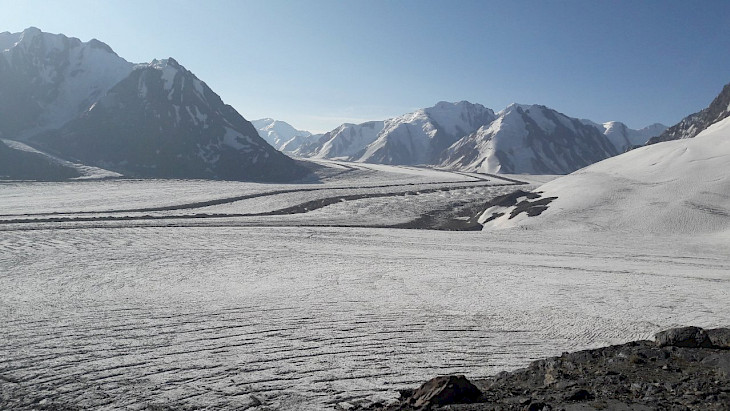
On photo: the Fedchenko Glacier in Tajikistan (by Meteo.tj)
CentralasianLIGHT.org,
November 15, 2026