
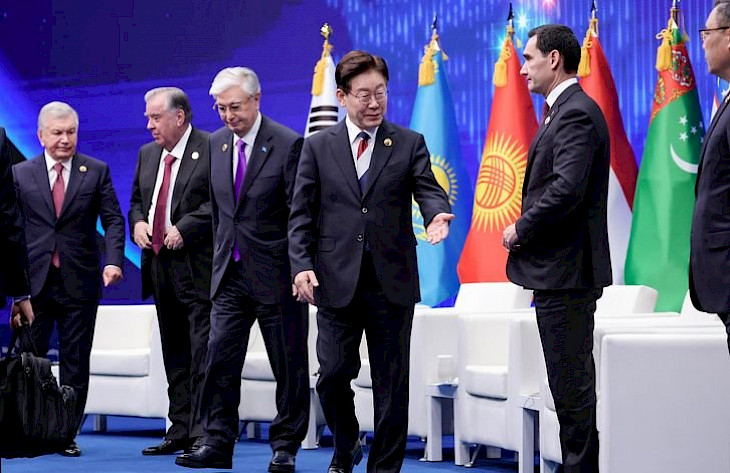
President Lee Jae Myung walks off the stage with the leaders of five Central Asian countries after the first Korea-Central Asia Summit at a hotel in Seoul, Wednesday. From left are Uzbekistan President Shavkat Mirziyoyev, Tajikistan President Emomali Rahmon, Kazakhistan President Kassym-Jomart Tokayev, Lee, Turkmenistan President Serdar Berdimuhamedov and Kyrgyzistan President Sadyr Japar. Photo: Yonhap
Seoul hosted the inaugural Korea-Central Asia Summit last Wednesday, with 74 bilateral agreements and MOUs signed and one unified “Seoul Declaration” given. This diplomatic gathering marked the first time all five Central Asian states — Kazakhstan, Uzbekistan, Kyrgyzstan, Tajikistan and Turkmenistan — met in Korea, following a similar format to the United States’ “C5+1” initiative, last held in 2025.
The summit represents a significant elevation in relations between Korea and Central Asia. Korea first recognized the Central Asian states’ independence from the Soviet Union in 1992, and has been a consistent source of foreign direct investment (FDI) since. At the end of last year, South Korea contributed $6.4 billion in FDI to the region. An all head-of-state level gathering signals a new era of relations.
The region’s ties to Korea extend beyond the political to the personal as well. Central Asia is home to nearly a third of a million ethnic Koreans deported to the region in 1937 by Joseph Stalin, then leader of the Soviet Union. Today, around 100,000 of their descendants have moved to Korea on the overseas Koreans visa, pursuing higher education and jobs in manual labor, technology and import-export.
But Korea’s connections to Central Asia are much more developed than these surface-level figures suggest. Media coverage of the event can simplify the region's complexity, somewhat obscuring the interests and diversity of Korea's hundreds of thousands of Central Asian residents, too. Understanding the reach of Korean engagement in the region requires unpacking the five Central Asian states into their sovereign units.
Kazakhstan is by far Korea’s strongest partner in the region. It alone hosts 62 Korean franchises and claimed over 50 percent of Korea’s investments in the entirety of Central Asia in 2025. It operates over 1,000 joint ventures and factories with big Korean conglomerates. Kazakhstan has been able to leverage its significant natural resources, such as critical minerals and oil, in its partnership with Korea among other middle-power states looking to diversify their supply dependencies.
Uzbekistan follows with near 30 percent of Korea's investment in the region from 2025. Korea is in the list of top investors in Uzbekistan, which is also a significant base for Korean factories. Notably, Uzbekistan pledged to add the Korean language to its roster of national language competition tongues this week, as it represents the region's largest sending-country by numbers of labor migrants to Korea.
The other states have less a little mobility to negotiate bilateral relationships with Korea. Turkmenistan is a highly controlled, comparable to North Korea in some ways, although this summit may signal some thawing. Kyrgyzstan and Tajikistan both rely on China for trade, boasting less diverse trade portfolios compared to Uzbekistan, for example, whose largest trading partner is also China. The bilateral compatibility with Korea of each state varies widely.
In the interest of creating an image of unity, the “C5” format also lets all parties involved put aside the human rights records of each state, which vary but are poor across the board. Uzbekistan and Turkmenistan rank lowest in the region, even as Uzbekistan is one of Korea’s stronger partners in the region. Korea has in recent years positioned itself as a leader in global human rights and is currently a member of the U.N. Human Rights Council.
Korea approaches these diverse partners as a group of five states in order to strengthen its symbolic position in the world order. The Central Asian region is often treated as the playing field of greater powers — such as China with its Belt and Road Initiative, or Russia’s overtures to its former satellites.
Korea is positioning itself as a safe, commercially driven alternative to regional hegemons by using the C5 framing. This is one of the country’s strongest appeals to the Central Asian states. It has been courting the region with its “K-Silk Road” vision since former President Yoon Suk Yeol visited Kazakhstan, Uzbekistan and Turkmenistan in 2024.
However, by rhetorically grouping the five vastly different states together, Korea may limit bilateral opportunities in the long run. Framing the region as a unified whole with shared interests in Korea could lessen Seoul’s and the five states’ ability to break free of middle-power symbolism. If negotiating as a bloc protects both Korea and the Central Asian states from blowback from its bigger neighbors, then it also inherently admits the risk of striking out on a boldly bilateral path.
On the one hand, the actual outcomes of the summit — namely, the 74 bilateral agreements and MOUs signed — reflect the real economic priorities of Korea’s plans for the five states. But on the other hand, domestic media and official statements surrounding the high-level talks suggest that Seoul is softening its diplomatic aims with the C5 bloc format.
The framing of Central Asia as a bloc is not only reminiscent of Cold War politics, but also of “the Great Game,” or Great Britain’s competition with imperial Russia to dominate the region. Korea, itself a post-colonial state, is well-positioned to navigate the sensitivities of such rhetoric with empathy and generosity, having far outpaced predicted development trajectories since the 1970s during rapid industrialization.
The five Central Asian states have an interest in building an autonomous industrial capacity, much like Korea’s “Miracle on the Han River.” Korea is a politically safe partner to build this capacity alongside, and presents an opportunity to leave behind the transactionality of the “C5” bloc. On the back of this summit, Seoul is poised to engage with its Central Asian peers on a level playing field and leave behind the rhetoric of the past.
Nathalie M. Kwon is a visiting researcher at Hankuk University of Foreign Studies. Her specialty is in migration and exchange between Central Asia and Korea. The views expressed in this column are the author’s own and do not necessarily reflect The Korea Times’ editorial stance.
Source: https://www.koreatimes.co.kr/southkorea/globalcommunity/
CentralasianLIGHT.org
September 18, 2026