
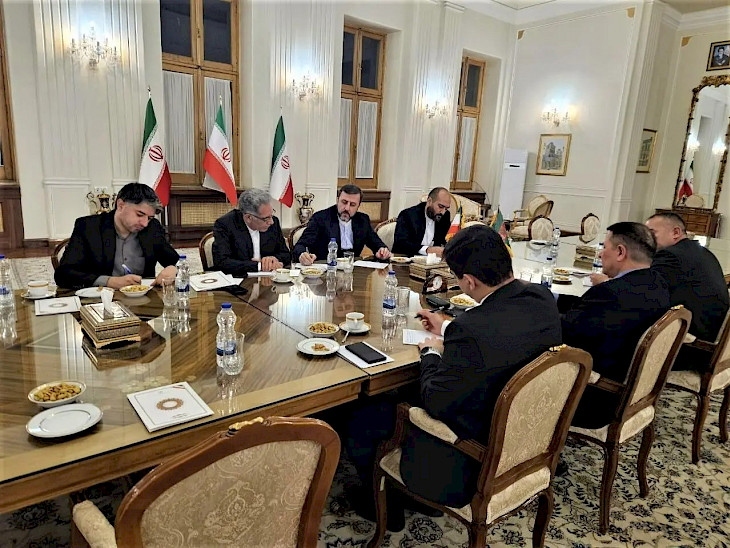
The Caspian agenda has always held a prominent place in the dialogue between Ashgabat and Tehran. Iranian Deputy Foreign Minister Kazem Garibabadi and Turkmenistan’s Special Representative for Caspian Affairs, Murad Atajanov, held consultations, outlining the contours of bilateral cooperation for the coming year, according to the Iranian news agency IRNA.
Both sides reaffirmed their commitment to the Convention on the Legal Status of the Caspian Sea, signed in Aktau in 2018, emphasizing the importance of its consistent implementation—particularly regarding the delimitation of maritime boundaries and the sustainable use of biological resources. To date, Iran has concluded a bilateral maritime boundary agreement only with Azerbaijan (2023), while negotiations with Turkmenistan remain in a constructive, working phase, marked by mutual respect for each other’s positions.
Discussions also covered preparations for the Seventh Caspian Summit, scheduled for summer 2026 in Tehran. This will be the first summit of the “Caspian Five” (Russia, Iran, Azerbaijan, Kazakhstan, and Turkmenistan) following the full ratification of the 2018 Convention by all littoral states. The previous, Sixth Summit took place in June 2024 in Aktau. The two countries have already initiated coordination to ensure the presidential meeting yields concrete agreements in the fields of security and transport. A key priority is advancing the Trans-Caspian International Transport Route (TITR), in which Turkmenistan serves as the pivotal overland link, while Iran functions as a critical logistics hub for access to the Persian Gulf.
One of the most sensitive topics addressed was the ongoing decline in the Caspian Sea’s water level. According to data from the Caspian Ecological Center at Lomonosov Moscow State University, the sea level has dropped by nearly 1.5 meters over the past 25 years, with a further 38 cm decline recorded between 2019 and 2024. This has led to significant shoaling near the ports of Krasnovodsk (Turkmenistan) and Bandar-e Anzali (Iran). In response, the diplomats discussed establishing a dedicated joint working group to monitor hydrological changes and develop adaptation measures for port infrastructure. Earlier, in May 2025, experts from all five Caspian states, meeting in Astrakhan at the Coordinating Council for the Protection of the Caspian Sea, approved the joint “Caspian-2030” program, aimed at scientific support for climate adaptation—including hydrological monitoring, scenario modeling, and data sharing via a unified digital platform.
Additionally, the talks addressed joint conservation of biological resources—particularly sturgeon protection and combating illegal fishing—as well as cooperation in renewable energy. Notably, the possible involvement of Iranian companies in constructing wind farms along Turkmenistan’s Caspian coast was discussed; the region boasts an average annual wind speed exceeding 8 m/s, offering strong potential for wind power generation.
At the conclusion of the meeting, the parties agreed to hold the next round of consultations in Ashgabat in March 2026—three months ahead of the anticipated summit date.
CentralasianLIGHT.org
December 24, 2025