
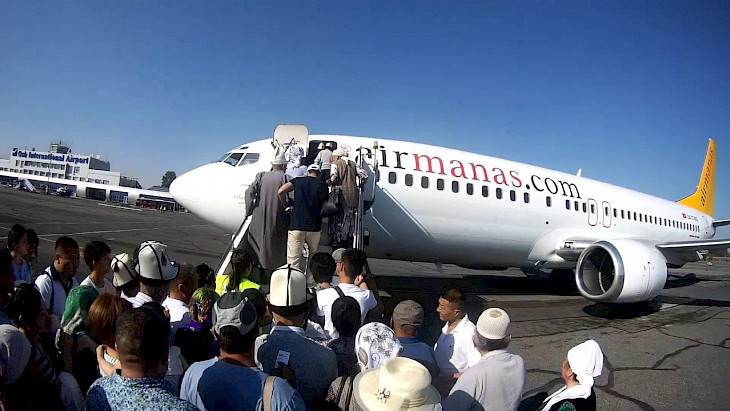
In Bishkek, passenger air travel declined in the first half of 2026, despite an overall increase in transport activity in the capital. According to official statistics, 787,700 passengers were carried by air from January to June—25,200, or 3.1%, less than the 812,900 passengers carried in the same period in 2025, Akchabar.kg reported.
Passenger turnover declined even more significantly. In the first six months of 2026, it totaled 836.6 million passenger-kilometers, compared to 1.0721 billion a year earlier. This represents a decrease of 235.5 million passenger-kilometers, or 22%.
The main reason for this discrepancy was the decrease in the average air travel distance. The estimated average travel distance per passenger decreased from 1,319 to 1,062 kilometers, or approximately 19.5%. This may indicate an increase in the share of shorter international and domestic routes or a change in the air travel structure.
Against this backdrop, overall passenger traffic in Bishkek, on the contrary, increased: 205.1 million passengers were carried by all modes of transport from January to June, 4.9% more than the previous year.
The decline in air passenger traffic, coupled with a relatively small drop in passenger numbers, primarily indicates a shift in the geography of travel. The share of short-haul flights has likely increased in the air travel structure, while the number of longer-haul flights has decreased. This may be due to changes in the route network, demand for individual destinations, and competition from rail and road transport.
CentralasianLIGHT.org
August 25, 2026