
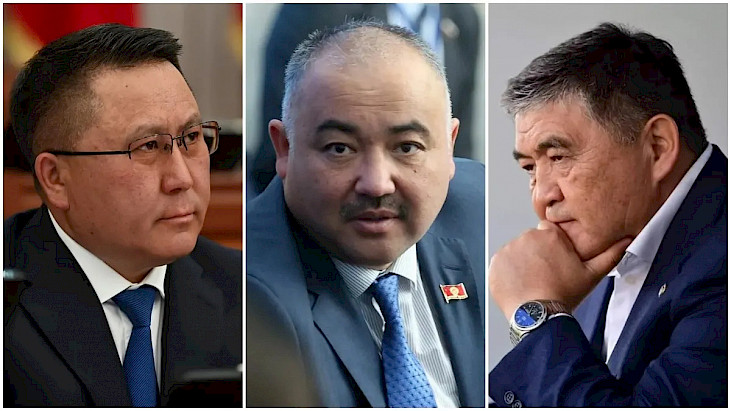
On July 2, the Pervomaisky District Court of Bishkek delivered its verdict in the high-profile case of the so-called "Letter of 75." All eight defendants were found guilty of violent seizure of power and sentenced to four years in prison with confiscation of property. The court also imposed three years of probation supervision, preventing them from being sent to prison.
Those convicted in the case include former Chairman of the State Committee for National Security Kamchybek Tashiev, former Prosecutor General Kurmankul Zulushev, former Speaker of the Zhogorku Kenesh Nurlanbek Turgunbek uulu, as well as Bekbolot Talgarbekov, Emilbek Uzakbayev, Kurmanbek Dyikanbayev, Aaly Karashev, and Kursan Asanov. The court acquitted all defendants of abuse of office. Five defendants who were in custody were released in the courtroom, their pretrial detention order being changed to travel restrictions.
The prosecution had previously requested nine years' imprisonment for each defendant. The defense insisted on a full acquittal. After the verdict was announced, the lawyers for Kamchybek Tashiev and Kurmankul Zulushev announced their intention to appeal the decision to a higher court.
The criminal case stems from an appeal by a group of politicians and public figures to President Sadyr Japarov and the then-Speaker of Parliament proposing to hold early presidential elections. The investigation characterized the "Letter of 75" not as a political initiative, but as part of a plan to change power.
The verdict can be seen as a compromise decision by the court. On the one hand, the guilty verdict means the court accepted the investigation's arguments regarding the presence of elements of a crime related to an attempt to violently seize power. On the other hand, the use of probation instead of actual imprisonment significantly mitigated the sentences compared to the prosecutor's request, which was for nine years in prison for each of the defendants.
The criminal case was initiated following the so-called "Letter of 75"—an appeal by a group of politicians, former government officials, and public figures to President Sadyr Japarov and the parliamentary leadership calling for early presidential elections. The investigation concluded that the document was part of a plan to destabilize the socio-political situation and unconstitutionally change the government.
The defendants themselves consistently denied these charges, claiming that the letter represented an exercise of citizens' right to express their political position and did not contain calls for violent action. It is precisely the differing legal assessments of the content and purpose of this appeal that have become the key focus of the trial, which is expected to continue in the appellate court.
CentralasianLIGHT.org
July 3, 2026