
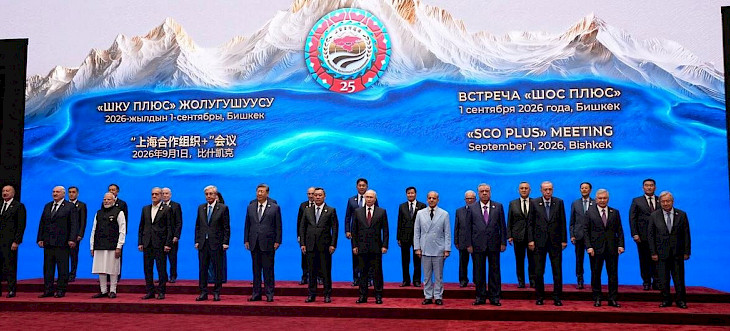
The past week has been one of the most eventful in Central Asia's political life in 2026. The regional agenda centered on the SCO summit in Bishkek, Chinese President Xi Jinping's state visit to Kyrgyzstan, the intensification of Central Asia's ties with South Asia and external partners, and the further strengthening of regional cooperation. CentralasianLIGHT.org publications show that several processes—Chinese, Russian, South Asian, and intraregional—are simultaneously influencing the formation of a new geopolitical architecture in Central Asia.
1. Bishkek has become the center of regional diplomacy
The main political event of the week was the Shanghai Cooperation Organization summit in Bishkek on September 1. Kyrgyzstan concluded its chairmanship of the organization for 2025–2026, and the summit participants adopted 28 documents, including the Bishkek Declaration and amendments to the SCO Charter. The agenda included not only security and the fight against terrorism and drug trafficking, but also energy, logistics, artificial intelligence, digital infrastructure, climate, and environmental safety.
Thus, as CentralasianLIGHT.org's analysis shows, the SCO is gradually expanding beyond the organization initially perceived primarily as a security mechanism. Economic connectivity, transport corridors, digitalization, and new technologies are becoming key areas of its activity.
The roadmap for the development of ports and logistics centers through 2030 is of particular importance for Central Asia. This is in line with the region's overall trend of transforming transport connectivity into a key instrument of economic and foreign policy.
2. Kyrgyzstan and China: Transition to a Long-Term Strategic Partnership
The second key event was the state visit of Chinese President Xi Jinping to Kyrgyzstan, which began on August 30. Following the talks between Presidents Sadyr Japarov and Xi Jinping, 32 bilateral documents were signed, including the Treaty of Eternal Good-Neighborliness, Friendship, and Cooperation. These documents cover transport, trade, investment, agriculture, and digital technologies.
It is significant that the Chinese leader described relations as being in a "golden period." For Bishkek, China remains one of its top foreign policy priorities and a key trade and investment partner.
The China-Kyrgyzstan-Uzbekistan railway occupies a special place. Its development demonstrates the transition of Kyrgyz-Chinese cooperation from primarily trade relations to the formation of long-term transport and infrastructure interdependence.
3. Kyrgyzstan Strengthens Ties with South Asia
Alongside Xi Jinping's visit, Bishkek hosted Pakistani Prime Minister Shahbaz Sharif. His visit from August 31 to September 2 concluded with the signing of 16 bilateral documents in the areas of trade, transport, energy, education, healthcare, e-commerce, and security.
The transit trade agreement was particularly important. It aims to facilitate cargo transportation and expand the use of Pakistani seaports to enable Kyrgyzstan to access international markets.
The political significance of this process extends beyond bilateral relations. Kyrgyzstan is seeking to simultaneously develop its foreign economic policy in China, South Asia, and other areas, leveraging its geographic location as a transit advantage.
4. India Strengthens Its Position in Central Asia
On the sidelines of the SCO summit, Tajik President Emomali Rahmon held talks with Indian Prime Minister Narendra Modi. The parties discussed political, trade, economic, scientific, educational, and humanitarian cooperation, as well as security issues.
Transportation is of particular interest. Tajikistan and India are interested in developing routes through Iran and the port of Chabahar. This allows Dushanbe to view India not only as a political partner, but also as a potential source of technology, investment, and access to new markets.
Thus, India is gradually strengthening its presence in Central Asia, offering the region an additional external vector alongside China, Russia, Europe, and other partners.
5. Uzbekistan Proposes a New Model of Regional Integration
Uzbek President Shavkat Mirziyoyev's proposal to develop the concept of "SCO 2040: Space for Common Development" has sent a significant political and economic signal. Tashkent proposes focusing on investment, technology exchange, infrastructure, and industrial projects.
Equally important is the initiative of Central Bank Chairman Timur Ishmetov to view Central Asia as a single investment market, rather than a collection of competing national economies.
This reflects a qualitative shift in regional thinking. Countries are gradually beginning to view neighboring states not only as competitors for investment, but also as elements of a single economic space.
6. Kazakhstan: Multi-vector approach and a new political architecture
At the SCO Plus summit, Kazakh President Kassym-Jomart Tokayev spoke about the need to maintain the central role of the UN in the international system. He also emphasized that Kazakhstan views the SCO as a mechanism for strengthening multilateral cooperation, not as an alternative to the UN.
At the same time, Tokayev noted domestic political changes in Kazakhstan. The new Constitution, which entered into force on July 1, and the creation of a unicameral Kurultai (parliament), are shaping a new architecture for public administration.
Externally, Kazakhstan continues to pursue a balanced and multi-vector diplomacy, which is particularly noticeable given its expanding contacts not only with major powers but also with Asian countries. This week, in particular, talks were held with the President of Laos, with a particular focus on transport cooperation and the potential of the China-Laos railway.
7. Turkmenistan: Energy Diplomacy Continues
Energy cooperation remains an important area of foreign policy for Turkmenistan. CentralasianLIGHT.org separately analyzed the strategic significance of the TAPI (Turkmenistan-Afghanistan-Pakistan-India) project, which aims to provide Ashgabat with access to the large South Asian market.
At the same time, gas cooperation with China continues to deepen. The modernization of the Central Asia-China gas pipeline infrastructure demonstrates that the energy partnership between Ashgabat and Beijing is becoming increasingly long-term in terms of infrastructure.
8. Kyrgyzstan's Railway Diplomacy Becomes Multi-Vector
An interesting event of the week was Kyrgyzstan's discussion with the United States regarding the possible participation of American financial institutions and Wabtec in the development of railway infrastructure. This included discussions on possible financing mechanisms for railway projects.
This is important to consider in the context of the construction of the China-Kyrgyzstan-Uzbekistan railway. For Bishkek, the American proposal represents an opportunity to diversify its sources of financing and technology without abandoning cooperation with China.
General conclusion
The week of August 30th – September 5th demonstrated that Central Asia is entering a new phase of foreign policy activity. For several days, Bishkek became the region's diplomatic capital, hosting the SCO summit, leader visits, and the 6th World Nomad Games.
The main trend is that Central Asian countries are striving not to choose a single external partner, but to simultaneously expand their network of connections. China is strengthening its infrastructural and political presence, India and Pakistan are intensifying their South Asian activities, the United States is showing interest in transport infrastructure, and Kazakhstan, Uzbekistan, and other countries continue to develop relations with Europe, Russia, the Middle East, and Asia.
At the same time, a new logic is gradually emerging within the region: away from competition among individual states and toward complementarity between economies and infrastructures. Therefore, proposals for a single investment market for Central Asia, the development of transport corridors, and expanded energy cooperation could become key elements of regional policy in the coming years.
In this sense, the events of the first week of September 2026 demonstrated that Central Asia is increasingly transforming from an object of geopolitical rivalry into an independent participant in the emerging Eurasian system of connections.
CentralasianLIGHT.org
September 6, 2026