
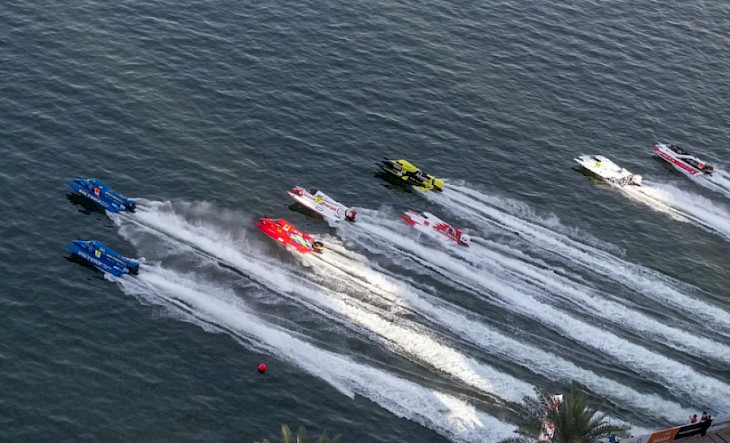
Following the international stage of the UIM F1H2O championship in Issyk-Kul, specialists from the Ministry of Natural Resources, Ecology, and Technical Supervision of Kyrgyzstan found no contamination of water, soil, or coastal areas, 24.kg reports.
The competition took place from July 31 to August 2 near the village of Baet on the northern shore of Lake Issyk-Kul. Inspectors monitored the waters, mooring areas for racing boats, temporary garages, and other infrastructure. No spills of fuel or lubricants were recorded.
To assess the impact of the race, specialists compared water samples taken on July 30 and August 3 near the motorboat pontoon and on the race track. Analysis of petroleum products, dissolved oxygen, and other parameters revealed no deterioration in water quality or exceedance of permissible limits.
After the competition, organizers were ordered to dismantle the temporary infrastructure and remove the equipment. By August 3, the racing boats were ready for shipment to Europe.
However, the environmental debate surrounding F1H2O did not end with the competition. Even before the event, environmental activists expressed concern that high-speed motorboats could pose a risk to the fragile ecosystem of Lake Issyk-Kul, a UNESCO biosphere reserve.
The results obtained after the competition provide an important argument that, with strict monitoring, such international events can be held without immediate damage to water quality. Furthermore, the environmentalists' position is also justified: the absence of contamination in samples immediately after the race does not mean the absence of long-term impacts on the ecosystem.
Therefore, it is crucial for Kyrgyzstan to move from one-time inspections to continuous independent environmental monitoring. The organizer itself announced a three-stage monitoring program—before, during, and after the competition.
If Kyrgyzstan intends to hold F1H2O in Issyk-Kul annually, the publication of complete monitoring data and the participation of independent environmental organizations could be key to reducing public mistrust. This will combine the competition's tourism and international appeal with the long-term goal of preserving the lake's ecosystem.
CentralasianLIGHT.org
August 11, 2026