
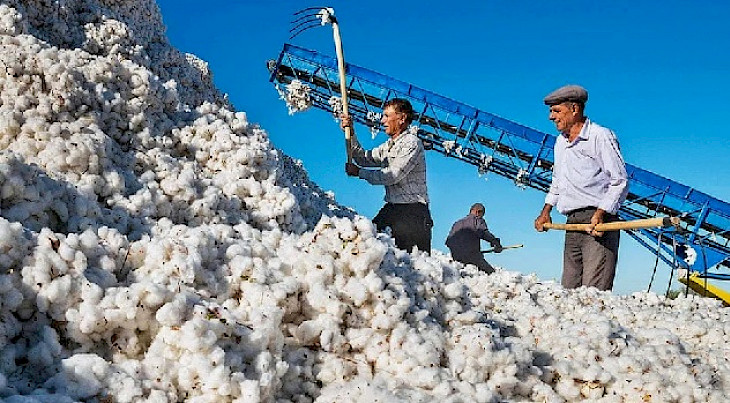
Uzbekistan’s President Shavkat Mirziyoyev has, for the first time, sharply criticized the previous state of the country’s cotton industry, saying that for nearly three decades the system functioned without a scientific approach and relied almost entirely on heavy manual labor. He made the remarks during a meeting with farmers in the Syrdarya region, Asiaplus.tj reports.
According to the president, the old management model in cotton production meant that people were sent to the fields en masse without proper knowledge, equipment, financing, or respect for the work of specialists. “We suffered for 27 years because of this cotton; everyone worked in the fields, yet we achieved nothing,” he said, adding that “people’s mindset has changed, and now they see value in their labor.”
Mirziyoyev emphasized that yields had remained extremely low — in Syrdarya, farmers could not even harvest 25 centners per hectare, and production costs exceeded income. Today the situation is different: the president cited farmers who achieved yields of 85 and 76 centners per hectare, noting that such results became possible thanks to new technologies, scientific support, and farmers’ personal motivation.
By 2026, Uzbekistan plans to increase its cotton harvest to 4.5 million tons (compared to 3.765 million tons in 2025). To boost productivity, the government proposes introducing a mentorship system: experienced farmers producing over 60 centners per hectare will be paired with those lagging behind. Successful mentors will receive a bonus of 5 million soums (about $417).
Mirziyoyev also recalled the long history of forced labor in the cotton sector — from the Soviet period to the rule of Islam Karimov. Mass mobilization of students, schoolchildren, and employees for cotton picking led to an international boycott of Uzbek cotton. However, after Mirziyoyev’s reforms, this practice ended: in 2022, Cotton Campaign lifted its restrictions, and the United States removed Uzbek cotton from the list of goods associated with child and forced labor.
Today, Uzbekistan is focusing on full-cycle processing: while in 2017 only 40% of cotton fiber was processed domestically, the figure has now reached 100%. Moreover, due to growing industrial capacity, the country is preparing to import cotton — including from the United States — to meet the needs of its expanding textile sector.
CentralasianLIGHT.org
December 9, 2025