
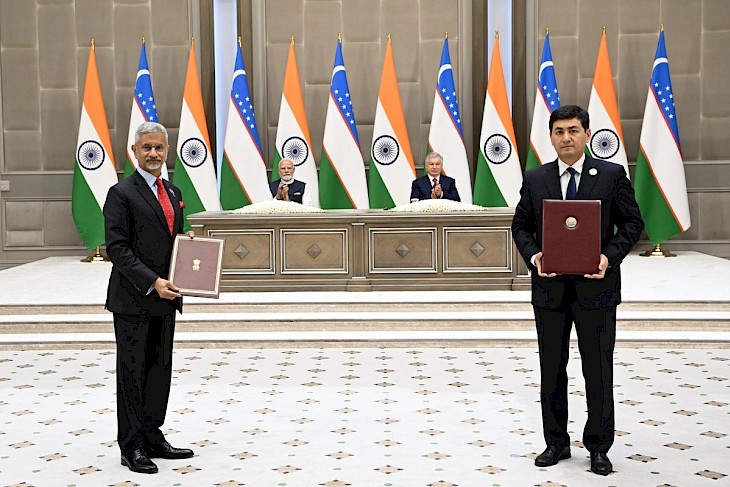
Uzbekistan and India are close to signing a new long-term agreement on the supply of Uzbek uranium to India. This was announced by Sibi George, Secretary for Western Affairs at the Indian Ministry of External Affairs, following talks between Prime Minister Narendra Modi and President Shavkat Mirziyoyev, Gazeta.uz reported.
According to him, the parties held positive talks and are "very close" to concluding an agreement.
For Uzbekistan, the agreement is of not only commercial but also strategic importance. The country is among the world's leading uranium producers, and expanding production and export contracts are becoming an important part of its raw materials and foreign economic policy. In 2025, Uzbekistan produced approximately 7,000 tons of uranium, significantly increasing its output from the previous year. According to Navoiyuran, the company's revenue reached $1.11 billion, underscoring the growing economic importance of the industry.
The country's uranium reserves are also estimated to be significant. According to Uzbek authorities, proven reserves amount to approximately 139,000 tons, while international estimates also confirm the presence of significant recoverable resources. The country continues to expand geological exploration and plans to further expand its mineral resource base.
India's interest stems from the rapid development of its nuclear energy sector. The country is seeking to significantly increase its nuclear capacity and therefore requires a stable supply of natural uranium. Currently, India relies on imports and purchases uranium from, among others, Kazakhstan, Russia, Canada, and Uzbekistan.
The new contract could strengthen Uzbekistan's position as a reliable supplier of nuclear raw materials. However, cooperation is not limited to uranium. Tashkent and New Delhi agreed to explore joint projects in geology, mineral extraction and processing, critical minerals, and the peaceful uses of nuclear energy.
Uranium is thus becoming a key element in deepening the two countries' strategic partnership. For Uzbekistan, this represents an opportunity to increase exports and attract Indian technology and investment, while for India, it offers the opportunity to diversify its sources of this vital raw material for nuclear energy.
CentralasianLIGHT.org
September 2, 2026