
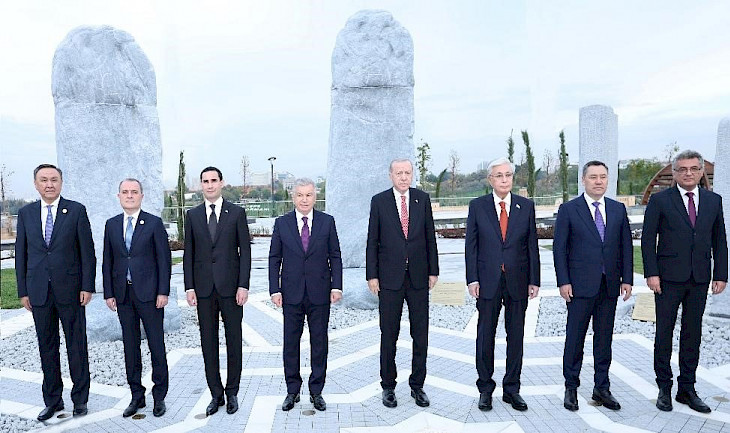
Overview: Turkic Summit in Ankara and a Wave of Development Finance
The last week of October showed Central Asian states engaging with several partners at once. The 13th summit of the Organization of Turkic States (OTS) in Ankara changed the organization’s leadership and honoured Kyrgyzstan’s president. In Samarkand, the C5+1 ministerial meeting gave Kyrgyzstan a chance to raise sensitive visa and sanctions issues with Washington. At the same time, development banks and foreign partners committed large sums to energy, water and infrastructure: a $900 million EBRD roadmap for Tajikistan, a $371 million grid modernization project in Uzbekistan, and nearly $1.85 billion already invested in Kazakhstan’s water sector. Statistics released during the week on poverty, small business, foreign investment and healthcare staffing round out the picture of the region’s economies.
Diplomacy and Regional Institutions
Leadership Change at the Organization of Turkic States
At the Ankara summit, the Council of Heads of State appointed Uzbek Deputy Foreign Minister Mirvohid Azimov as Secretary General of the OTS. He succeeds Kubanychbek Omuraliev of Kyrgyzstan, who had led the secretariat since November 2022. During Omuraliev’s term the Turkic Investment Fund was launched with authorized capital of $500 million, an agreement on a simplified customs corridor was signed, and joint logistics projects along the Middle Corridor expanded. Azimov previously served as Deputy Secretary General for political, transport and economic cooperation. He is expected to focus on the “Turkic World 2040” strategy, particularly economic integration and digital logistics. The OTS chairmanship passed to Türkiye at the same summit.
Japarov Awarded the Highest Order of the Turkic World
Kyrgyz President Sadyr Japarov received the Supreme Order of the Turkic World at the presidential palace in Ankara. The award was approved unanimously by the presidents of Azerbaijan, Kazakhstan, Türkiye and Uzbekistan and presented by President Recep Tayyip Erdoğan. In his remarks Japarov emphasized the shared history and culture of Turkic peoples. He also set out Kyrgyzstan’s interest in trade, investment and transport connectivity within the organization.
C5+1 Sidelines: Kyrgyzstan Raises the Visa Bond Issue
In Samarkand, Kyrgyz Foreign Minister Jeenbek Kulubayev met U.S. Secretary of State Marco Rubio. Kulubayev asked Washington to reconsider the Visa Bond pilot programme, under which Kyrgyz applicants for business and tourist visas have had to post deposits of $15,000–20,000 since early 2026. The two also discussed U.S. secondary sanctions affecting Kyrgyzstan’s banking sector. They agreed to continue consultations through consular and financial intelligence channels.
Other diplomatic highlights:
- Uzbekistan – Qatar: President Shavkat Mirziyoyev held talks in Tashkent with Emir Sheikh Tamim bin Hamad Al Thani on joint projects in energy, transport, infrastructure and the green economy. The visit reflects Tashkent’s push to attract investment from the Gulf.
- Turkmenistan – UNDP: Foreign Minister Rashid Meredov and UNDP Resident Representative Narine Sahakyan discussed implementing the 2026–2030 Cooperation Framework. Its priorities are digital transformation, public administration reform, environmental protection and sustainable growth.
- Turkmenistan: An international conference in Ashgabat marked the 30th anniversary of the Institute of State, Law and Democracy. It focused on the country’s international legal initiatives and on bringing national legislation into line with human rights standards.
- Travel advisory: The U.S. State Department updated its global ratings and placed Kazakhstan, Kyrgyzstan, Uzbekistan and Turkmenistan at Level 1, “Exercise Normal Precautions”. Tajikistan remains at Level 2.
Energy, Climate and Critical Minerals
Tajikistan and the EBRD Agree on a $900 Million Roadmap
President Emomali Rahmon and EBRD Vice President Matteo Patrone discussed a $900 million investment roadmap for 2026–2030. It focuses on green energy, grid modernization and private investment in solar power plants. Since 1993 the bank has invested more than €1.1 billion in 201 projects in Tajikistan. Dushanbe also asked for more direct financing for small and medium-sized businesses, more lending in somoni and support for corporate bond issues. Water supply, irrigation, digitalization and education were also on the agenda.
$371 Million to Modernize Uzbekistan’s Power Grid
The World Bank’s Board approved a $100 million loan to make Uzbekistan’s electricity distribution more efficient and reliable. With $200 million from the Asian Development Bank and $71 million from the government, the project totals $371 million. It will modernize and digitalize 60 key substations of National Electric Grids of Uzbekistan. By 2031 it aims to cut losses by 20,000 MWh a year, reduce emissions by 23,000 tonnes, integrate 3.3 GW of renewable capacity and create about 11,700 jobs.
Caspian Hydrocarbons and the European Market
Turkmenistan’s energy sector made news on several fronts:
- Dragon Oil: The UAE-based company, part of the ENOC group, plans to raise output in the Cheleken contract area to 200,000 barrels of oil equivalent per day by 2030. It currently produces about 60,000–70,000 barrels per day, roughly 35–40% of Turkmenistan’s liquid hydrocarbons. The company has invested nearly $12 billion since 2000 and wants to extend its partnership beyond 2035, when its production sharing agreement expires.
- Gas for Europe: In Brussels, Ambassador Sapar Palvanov met the leadership of IOGP Europe to discuss Caspian infrastructure and Turkmen gas supplies to the EU. The meeting touched on the possibility of linking the Galkynysh field to the Southern Gas Corridor via a Trans-Caspian route.
- Methane: The European Union pledged to support Turkmenistan’s efforts to cut methane emissions and develop renewable energy under the Global Methane Pledge. The support includes technology sharing and satellite monitoring of leaks.
Japan and UNDP Back Rare Metals Supply Chains in Kazakhstan
Japan and UNDP launched a $3 million initiative to develop environmentally sound value chains for rare earths and rare metals in Kazakhstan. It covers green extraction technologies, stronger environmental governance and lower pollution risks. Kazakhstan’s Ministry of Industry and Construction said the project supports national plans for high-value domestic processing of minerals.
Water, Environment and Science
Kazakhstan Invests Nearly $1.85 Billion in Water Infrastructure
Minister of Water Resources and Irrigation Nurzhan Nurzhigitov reported that investment in the sector has reached about 1 trillion tenge (around $1.85 billion) since September 2023. Over the past two years, more than 1,400 km of canals, five reservoirs and eight hydraulic structures have been rebuilt. Work is under way on 4,600 km of irrigation networks, and 964 km are due for completion by year-end, improving water supply to 200,000 hectares. The challenge is serious: up to 50% of irrigation water is lost in worn-out canals, 45% of river flow comes from neighbouring countries, and transboundary flow may fall by 12–15 km³ by 2040.
China to Build an Environmental Laboratory in Dushanbe
The National Academy of Sciences of Tajikistan agreed with the Science and Technology Department of China’s Xinjiang Uyghur Autonomous Region to build a new laboratory at the Central Asian Research Center for Ecology and Environment. It will strengthen monitoring of climate change, glaciers and water resources. The two sides also plan joint research in energy, geology, seismology and artificial intelligence.
Trade, Transport and Eurasian Integration
- Kazakhstan – EAEU: The Kurultai ratified a protocol making 30 amendments to the Treaty on the Eurasian Economic Union. At Astana’s initiative, bank guarantees for public procurement will now be recognized in all member states, so Kazakh companies can bid in a market estimated at $190–200 billion. Kazakhstan’s trade with the EAEU reached $30.9 billion in 2025.
- Kyrgyzstan – Torugart: Traffic at the Torugart checkpoint on the Chinese border rose to 538 trucks a day in October, almost 50% more than in the first half of the year. New lanes opened in July, inspection time has fallen to about 10 minutes, and an “Intelligent Checkpoint” system now manages vehicle flow. Cargo volume grew 28% in the first nine months to more than 2.1 million tonnes.
- Uzbekistan – Iran: The Uzbekipaksanoat Association and Iranian business representatives signed a memorandum on silk production. It covers supplying Uzbek silk to makers of Iranian hand-woven carpets and setting up direct links between producers.
Macroeconomy, Business and Finance
Tajikistan Expects Budget Revenues to Rise by 23%
At a government meeting on 29 October, Tajikistan reviewed the draft 2027 budget, which projects revenues of 80.1 billion somoni. That is 23.2% above the 2026 target. About 45% of spending is planned for the social sector. Growth is expected to come from a wider tax base, hydropower, electricity exports and mining. Officials acknowledged that the plan depends on external conditions, a stable currency and controlled inflation.
Separately, the National Bank of Tajikistan concluded an IMF technical assistance mission (October 15–23). The IMF experts welcomed the bank’s reforms in reserve requirements, liquidity management and linking its securities to the key rate. They also discussed developing the interbank market and strengthening cybersecurity.
Kyrgyzstan: Small Business and Foreign Capital
New statistics show the growing weight of the private sector in Kyrgyzstan:
- Small and medium-sized businesses produced 50.9% of GDP in 2025, about $11.5 billion. The country has 27,200 SMEs, 479,000 farms and nearly 505,000 individual entrepreneurs. The average SME wage of about $396 is still below the national average.
- Foreign-invested enterprises produced 215.3 billion soms of goods in 2025, or 26.3% of industrial output. In Talas region the share reached 90.3%. Net foreign direct investment rose 27.3% to $1.31 billion.
Social Development
- Uzbekistan – poverty: Citing World Bank data, Uzbekistan ranks among the top five countries for poverty reduction. In the first nine months of 2026 the poverty rate fell from 5.8% to 3.6%, from 2.2 million to 1.4 million people. 824,000 people found permanent jobs and 980,000 moved out of the informal sector. The government has adapted Chinese targeted poverty-reduction methods, including digital registers of households in each mahalla.
- Kazakhstan – doctors: The Ministry of Health reported that the national shortage of physicians fell by 20.4%. It credited support for young specialists, larger relocation payments for rural areas and expanded residency programmes.
- Tajikistan – health funding: Health Minister Jamoliddin Abdullozoda said at a summit in Samarkand that healthcare funding has increased 2.5-fold over five years. The money has gone into infrastructure, service quality and digital tools such as electronic birth registration and vaccination tracking.
Analysis: Tajikistan’s Growing Room for Manoeuvre
The site also republished an essay by Stephen Blank of the Foreign Policy Research Institute, “Tajikistan Steps Out and Stands Up”. Blank argues that Russia’s weakened economic and military position is giving Dushanbe more freedom of action. He points to Tajikistan’s oil imports from Iran since August 2026, air-defence systems bought from India and China, and decisions by Tajik banks affecting Russian clients. He also stresses the limits. Tajikistan depends on remittances from Russia and needs Moscow’s help with security on the Afghan border, so its room to manoeuvre remains much smaller than that of Kazakhstan or Uzbekistan.
Conclusion and Looking Ahead
The week’s news shows the region pursuing a multi-vector approach in practice. Turkic integration deepened in Ankara, dialogue with Washington continued at the C5+1, Gulf, European, Japanese and Chinese partners took part, and the EAEU framework was updated. The common thread is infrastructure: power grids, canals, border crossings and Caspian energy routes are now the main subjects of cooperation. The coming weeks will show whether the commitments are carried out. Points to watch include the first projects under the EBRD’s Tajikistan roadmap, progress on Turkmen gas routes to Europe, Washington’s response to Bishkek’s visa request, and the first initiatives of the OTS under its new Secretary General.
CentralasianLIGHT.org,
November 1, 2026