
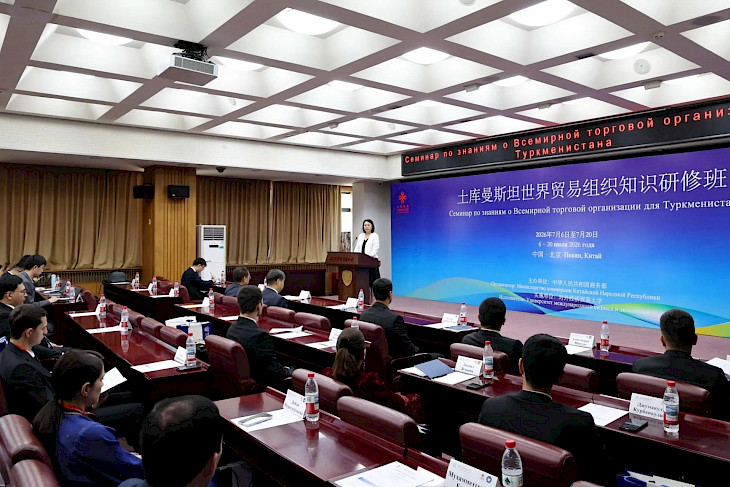
A specialized seminar for Turkmen civil servants on the workings of the World Trade Organization (WTO) and integration into the global economy has opened in Beijing. According to tmcell.tm, the course is being held from July 6 to 20 at the University of International Business and Economics (UIBE).
The program includes 12 thematic modules on trade policy, international negotiations, and government regulation of foreign trade. The Turkmen delegation will also visit Fujian Province, where they will learn about the development of the major industrial and logistics centers of Fuqing and Fuzhou.
The organizers note that China's experience in government regulation of trade is of particular interest to Turkmenistan, which continues its preparations for accession to the World Trade Organization.
Analytical Commentary
The holding of such a seminar reflects the high level of the strategic partnership between Turkmenistan and China, which has significantly strengthened over the past decade. While in the early 2010s, bilateral cooperation focused primarily on Turkmen natural gas exports, today it encompasses trade, transport, education, digital technologies, and government personnel training.
China remains Turkmenistan's largest foreign trade partner and the main buyer of Turkmen natural gas. Over the past ten years, cooperation has expanded thanks to the implementation of the Belt and Road Initiative, the development of transport corridors, and investments in energy infrastructure.
At the same time, Beijing provides Ashgabat with expert support on economic reforms and improving public administration.
For Turkmenistan, preparations for WTO accession are becoming a key focus of economic modernization. Studying China's experience is particularly important, as China has successfully leveraged WTO membership as a tool for accelerated economic growth, attracting foreign investment, and integrating into global production chains.
In the regional context, deepening cooperation between Turkmenistan and China reflects the overall trend of Beijing's growing economic presence in Central Asia.
In addition to energy, China is increasingly investing in infrastructure, industry, logistics, and human capital development, making it a key driver of the region's economic transformation.
CentralasianLIGHT.org
July 15, 2026