
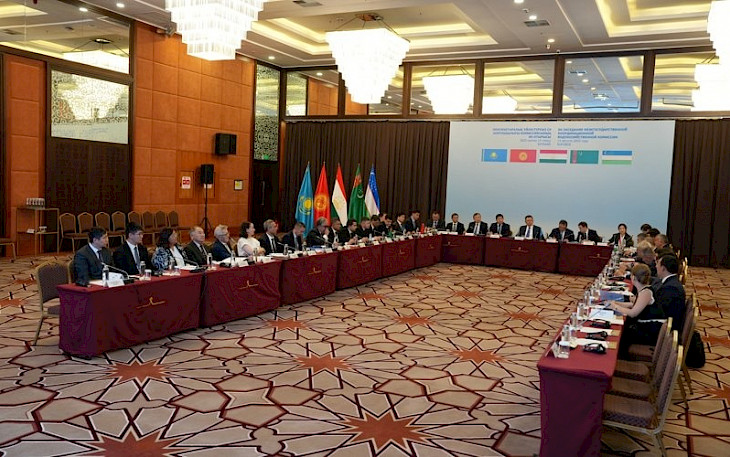
Tajikistan's Minister of Energy and Water Resources, Daler Juma, participated in the 94th meeting of the Interstate Commission for Water Coordination (ICWC) of Central Asia, which took place on August 6 in Turkestan, Kazakhstan. The main topic of the meeting was an assessment of the implementation of previously agreed water withdrawal limits and reservoir operating regimes in the Syr Darya and Amu Darya basins during the 2026 irrigation season, Asiaplus.tj reported.
New quotas were not approved at the meeting; they were agreed upon in April at the 93rd ICWC meeting in Bukhara. Participants discussed the progress of their implementation, as well as the implementation of decisions of the International Fund for Saving the Aral Sea.
The total water withdrawal limit for the Syr Darya for the growing season is 11.884 billion cubic meters, of which 1.905 billion cubic meters has been allocated to Tajikistan.
The volume of water allocated for the Amu Darya basin from April to October has been set at 39.772 billion cubic meters, including 7.052 billion cubic meters for Tajikistan.
Particular attention was paid to coordinating the operation of the Bahri Tojik reservoir, which is crucial for water supply to the border agricultural areas of Kazakhstan and Uzbekistan.
The ICWC meeting confirmed that water diplomacy remains a key mechanism for maintaining stability in Central Asia. Against the backdrop of climate change, increasing water demand, and expanding irrigated land, compliance with agreed limits is acquiring not only economic but also strategic significance.
For Tajikistan, participation in such meetings is particularly important, as the country is one of the main contributors to river flow in the region. Coordinating reservoir operation modes allows for the interests of both upstream states focused on hydropower and downstream countries whose economies depend on a stable water supply for agriculture to be taken into account.
Maintaining regular dialogue within the ICWC demonstrates that Central Asian states are increasingly focusing on joint management of transboundary water resources. This approach is becoming especially relevant in the context of increasingly frequent climate anomalies and the implementation of new infrastructure projects requiring closer coordination of water policies.
For the region, this is not only a tool for preventing potential disagreements but also a foundation for strengthening long-term cooperation in food, energy, and environmental security.
CentralasianLIGHT.org
August 7, 2026