
The week of September 7–13 showed that, following the intensive diplomatic agenda of early September, Central Asian countries focused increasingly on translating international agreements into concrete economic, infrastructure, and technology projects. Publications by CentralasianLIGHT.org highlighted four major trends: strengthening economic ties with China, expanding the region’s transport role, seeking new partners beyond traditional spheres of influence, and increasing attention to human capital, technology, and investment.
Uzbekistan Expands Its External Economic Geography
One of the most notable events was Uzbek President Shavkat Mirziyoyev’s official visit to Serbia on September 7–8. It was the Uzbek president’s first official visit to Serbia, giving the trip particular political significance. The two sides agreed to intensify trade and economic relations, parliamentary cooperation, and humanitarian contacts. They signed a plan for developing industrial cooperation for 2026–2028 and established an Uzbek-Serbian Business Council. Preparations also began for negotiations on a free trade agreement.
Particularly significant was the discussion of cooperation in the defense industry. Belgrade expressed readiness to cooperate with Uzbekistan in this field. Thus, Tashkent continues to pursue a multi-vector foreign policy, expanding ties not only with China, Russia, and the Central Asian countries, but also with European states.
Another important issue was human capital development. According to data published by CentralasianLIGHT.org, around 83% of graduates of Uzbek higher education institutions are employed. This indicates that education is increasingly becoming part of Uzbekistan’s broader strategy to improve the competitiveness of its economy.
China Strengthens Its Economic Presence
China remained one of the central themes of the regional agenda. On September 9, CentralasianLIGHT.org analyzed a new stage in relations between Kyrgyzstan and China following Chinese President Xi Jinping’s visit to Bishkek and the SCO summit.
More than 30 documents were signed between the two countries covering trade, transport, the digital economy, education, and energy. Particular importance was attached to the Treaty on Eternal Good-Neighborliness, Friendship and Cooperation. Practical areas of cooperation include accelerating construction of the China–Kyrgyzstan–Uzbekistan railway, modernizing border checkpoints, and developing artificial intelligence, clean energy, mining, and engineering education.
At the same time, Bishkek is increasingly seeking Chinese investment in new sectors. On September 11, CentralasianLIGHT.org reported on Kyrgyzstan’s efforts to promote investment projects involving major Chinese companies. This demonstrates a gradual transition from a model focused primarily on infrastructure and trade toward broader industrial and technological cooperation.
Kazakhstan: China, Khorgos and New Export Routes
Kazakhstan was at the center of several important economic developments this week. On September 8, reports focused on an agreement between Kazakhstan and China concerning security issues in the Khorgos area. Khorgos is becoming much more than a conventional border crossing: it is emerging as one of the key hubs connecting China with Central Asia and European markets.
On September 9, CentralasianLIGHT.org also highlighted the expansion of Kazakhstan’s oil exports to China and through the Caspian Sea. This reflects Astana’s efforts to preserve traditional energy markets while simultaneously diversifying export routes.
At the same time, the Kazakh economy continues to face domestic constraints. CentralasianLIGHT.org reported on continuing stagnation in the housing market. This demonstrates that strong performance in certain sectors does not eliminate structural problems related to domestic demand, housing costs, and investment risks.
Central Asia and the Middle Corridor
Transport connectivity is gradually becoming one of the main elements of the region’s economic strategy. This is particularly visible in Turkmenistan’s expanding cooperation with regional ports.
On September 11, CentralasianLIGHT.org reported on strengthening Turkmenistan’s interaction with regional ports within the framework of the Middle Corridor. For Ashgabat, this offers an opportunity to increase the importance of the Turkmenbashi port while strengthening connections with transport routes across the Caspian Sea, the Caucasus, and onward to Europe.
For Central Asia as a whole, this means the emergence of several competing but complementary transport directions. China–Kyrgyzstan–Uzbekistan is oriented toward China and the east; the Middle Corridor connects the region with the Caucasus and Europe; while traditional routes through Russia continue to retain their importance.
The region is therefore gradually transforming from a peripheral area of the Eurasian transport system into an independent transit hub.
Kyrgyzstan: Investment, Tourism and Infrastructure
Investment and domestic infrastructure were important themes for Kyrgyzstan this week. CentralasianLIGHT.org reported that foreign direct investment in tourism and recreation reached $87.8 million in 2025, compared with $11.2 million a year earlier. Investment from countries outside the CIS recorded particularly strong growth.
This indicates that Kyrgyzstan is gradually becoming a more visible international tourism destination. However, further growth will depend on infrastructure, service quality, transport accessibility, and the ability to transform investment into sustainable tourism products.
Another major project remains the construction of Bishkek Arena, estimated at around $386 million. The project is viewed not only as sports infrastructure but also as part of efforts to create a modern urban environment and increase the capital’s tourism appeal.
Tajikistan: Industry and Climate Risks
Tajikistan demonstrated this week both its ambition to develop industrial production and the need to adapt to climate change.
CentralasianLIGHT.org reported plans to launch iron production in 2027. The development of metallurgy corresponds to Dushanbe’s broader strategy of increasing domestic processing of raw materials and creating new industrial value chains.
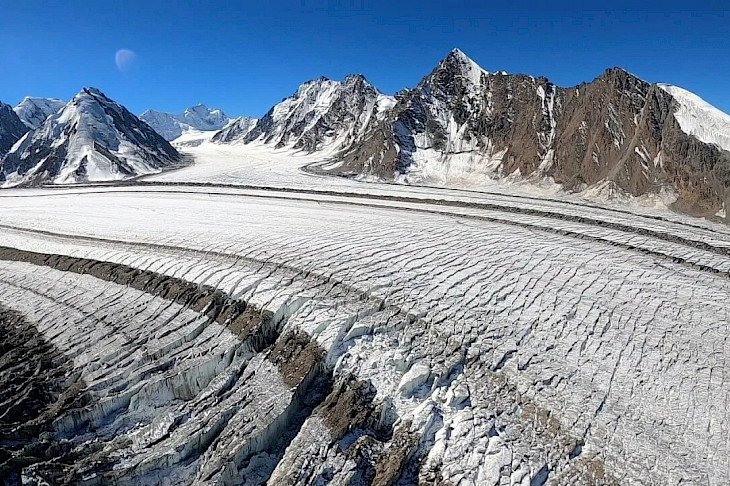
At the same time, Tajikistan is strengthening glacier monitoring. For a country whose water resources are closely linked to the condition of its glaciers, climate change is not only an environmental issue but also an economic one. Water, energy, and agriculture are becoming increasingly interconnected with climate policy.
The World Bank’s new country program is also significant. Tajikistan could potentially attract up to $1.8 billion in concessional and private financing over seven years. However, the actual volume of financing will depend on reforms, the investment climate, and the availability of resources.
Turkmenistan: Human Capital and External Relations
Turkmenistan continues to cautiously expand its international economic cooperation. This week included discussions of opportunities for Turkmen businesses within the B5+1 framework, as well as the development of parliamentary contacts with the United States.
Of particular significance is the introduction of a national strategic human capital planning system. For Turkmenistan, this is an important signal: amid the technological transformation of the economy, the quality of the workforce is becoming no less important than natural resources.
Security and Migration
A notable security-related development was the imposition of U.S. sanctions on a Kazakh company over alleged links to the Iranian airline Mahan Air. This demonstrates that Central Asian countries continue to face the risks of secondary sanctions and the need to balance relations with different external economic partners.
At the same time, Uzbekistan reported assistance in returning more than 96,000 of its citizens from Russia. Migration policy is gradually becoming part of Tashkent’s broader economic strategy, including professional training and the search for new foreign labor markets.
Main Conclusion of the Week
The week of September 7–13 demonstrated a shift in Central Asia from diplomatic activity toward the practical implementation of new international agreements. China is strengthening its investment and technological presence; Kazakhstan is developing export and transport routes; Uzbekistan is expanding partnerships with Europe while emphasizing human capital; Kyrgyzstan is seeking investment in tourism and new sectors; while Tajikistan and Turkmenistan are paying greater attention to industry, infrastructure, and workforce development.
The main trend is that Central Asia is increasingly moving away from being a single economic space dependent on a limited number of external partners. The countries of the region are simultaneously developing relations with China, Russia, Europe, South Asia, the Middle East, and the Caucasus.
This creates new opportunities for Central Asia but also requires greater coordination. In the coming years, the region’s competitiveness will be determined not only by the volume of foreign investment, but also by its ability to transform transport corridors, human capital, and technological cooperation into sustainable economic growth.
Photo: Asiaplus.tj
CentralasianLIGHT.org
September 13, 2026