
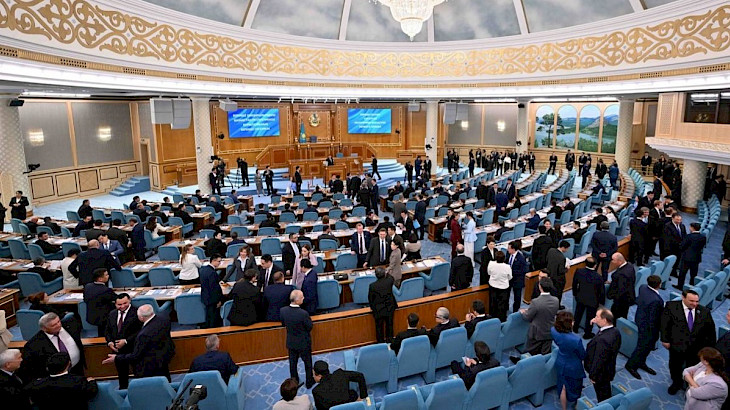
Kazakhstan began forming a new government architecture following the entry into force of the new Constitution and the first elections to the unicameral Kurultai. On August 31, President Kassym-Jomart Tokayev proposed candidates for the positions of vice president and prime minister to parliament.
The Kurultai supported the proposed candidates, after which the corresponding appointments were formalized. The new Constitution stipulates that the vice president is appointed by the president with the consent of the Kurultai, and the government is formed within the framework of the new system of interaction between the executive and legislative branches of government.
Olzhas Bektenov, who has headed the government since February 2024, has been reappointed prime minister. His retention in the post demonstrates a commitment to ensuring continuity of economic policy during a period of large-scale institutional restructuring. Key government objectives remain economic growth, increasing the efficiency of public spending, infrastructure development, supporting entrepreneurship, and implementing digital transformation.
Official government documents show that as early as August, the government's focus was on the 2027–2029 budget, socioeconomic development, cost optimization, and the development of the digital economy.
The creation of the position of vice president is one of the most notable innovations of the new political system. According to the Constitution, the vice president, upon instructions from the head of state, represents him in interactions with the Kurultai, the government, and other state bodies. Moreover, in the event of the early termination of the president's powers, the vice president becomes first in the constitutional line of succession.
Therefore, the renewal of Kazakhstan's top leadership should be viewed not simply as a personnel reshuffle, but as the beginning of the practical functioning of a new model of public administration.
Bektenov's retention ensures the continuity of executive power, while the institution of vice president should strengthen coordination between the president, the Kurultai, and the government. The main test of the new system will be its ability to translate large-scale constitutional changes into more effective governance, sustainable economic growth, and further modernization of Kazakhstan.
CentralasianLIGHT.org
August 31, 2026