
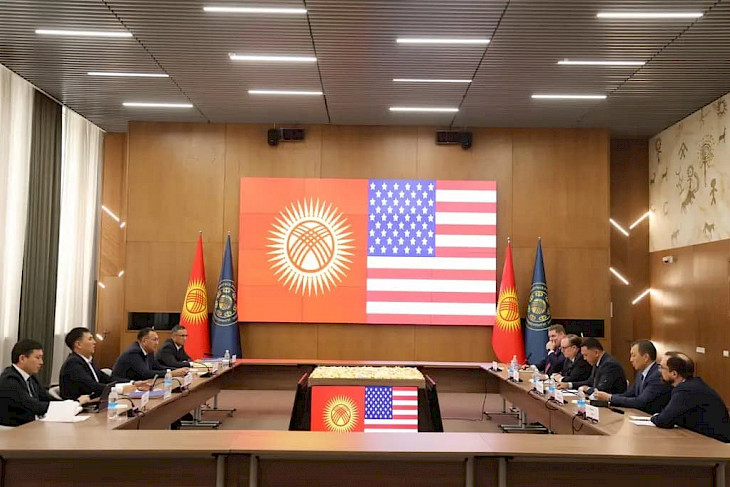
Finance Minister Ruslan Suinaliev discussed the prospects of railway projects in Kyrgyzstan and possible financing mechanisms with US Ambassador Leslie Viguerie and representatives of the American company Wabtec, Akchabar.kg reported.
The Kyrgyz Ministry of Finance emphasized that the American proposals are still under study and require detailed financial and legal considerations.
At the same time, the current negotiations logically follow up on an earlier US initiative. Back in November 2025, the Kyrgyz Ministry of Transport reported that the US Embassy was negotiating with the US Export-Import Bank and Citibank on possible financing for the construction of the Balykchy-Kochkor-Karakol railway line. Thus, Washington's interest in Kyrgyz railway projects is becoming more concrete: it is no longer just about political support, but also about finding financial instruments and the participation of American businesses.
Of particular significance is the arrival of Wabtec, one of the largest American companies in the rail industry, working with locomotives, control systems, digital solutions, and maintenance. The company has a global presence in over 50 countries, and its products are used in over 100.
This suggests that the American proposal could potentially include not only construction financing but also equipment supply, rolling stock modernization, digitalization of the rail infrastructure, and subsequent maintenance.
For Kyrgyzstan, diversifying its funding sources is of strategic importance. The country is simultaneously implementing the major China-Kyrgyzstan-Uzbekistan railway project, estimated to cost $4.7 billion. China is providing a loan of approximately $2.3 billion, with the remainder coming from contributions from the three countries.
At the same time, other rail routes are being developed, including the Makmal-Karakol route, which is being considered for a public-private partnership.
The current US interest should not be viewed as an alternative to Chinese participation, but as an opportunity to expand Kyrgyzstan's range of partners. For Bishkek, it is crucial to compare not the political attractiveness of proposals, but their cost, terms, lending conditions, risk distribution, and impact on public debt.
If the US side truly proposes a competitive model involving American financial institutions and Wabtec, Kyrgyzstan will gain an additional source of capital and technology. More broadly, competition among various financial and technology centers for participation in transport projects could strengthen Kyrgyzstan's negotiating position and turn its railway infrastructure into an important element of its multi-vector economic policy.
CentralasianLIGHT.org
September 3, 2026