
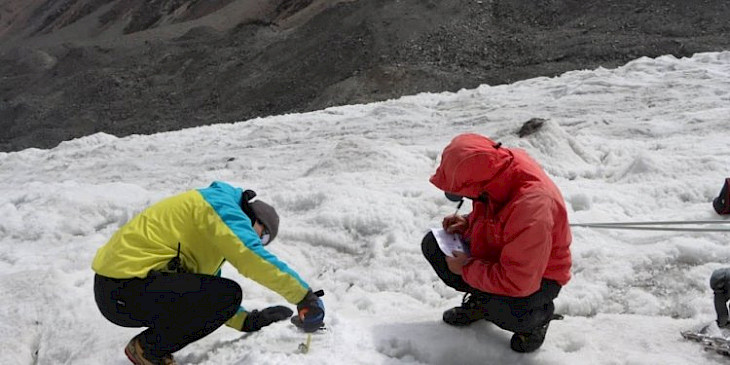
In August 2026, an international scientific research expedition was conducted in the Gorno-Badakhshan Autonomous Region of Tajikistan on glaciers No. 139 (Zulmart), No. 3, and No. 457. Specialists from the Institute for Glacier and Cryosphere Studies of the Academy of Sciences of Tajikistan and scientists from the Universities of Fribourg and Zurich participated. The expedition was part of the implementation of a UN resolution on the protection of glaciers and the cryosphere, Avesta.kg reported.
The main result of the research was the detection of a 1.5–2 meter decline in the ablation zone of glaciers No. 139 and No. 457. The scientists conducted glaciological, hydrological, and meteorological measurements, studying snowmelt and accumulation processes, the state of snow-firn layers, and water runoff parameters. Monitoring points and long-term monitoring equipment were also installed on the glaciers.
These findings have implications far beyond scientific research. Gorno-Badakhshan's glaciers are a vital source and regulator of water resources for Tajikistan and the entire Central Asian region. A 1.5-2 meter drop in their water levels demonstrates that climate change is already having measurable impacts in high-mountain regions.
For Tajikistan, systematic glacier monitoring is simultaneously an environmental, water management, and strategic objective. International collaboration with Swiss research centers allows for the use of modern technologies and the comparison of national observations with international research.
In the long term, such data is essential for water resource forecasting, risk assessments for agriculture and energy, and the development of regional climate change adaptation mechanisms.
CentralasianLIGHT.org
September 10, 2026